My Husband’s Secret Laptop Listed Me as “Stage Four”
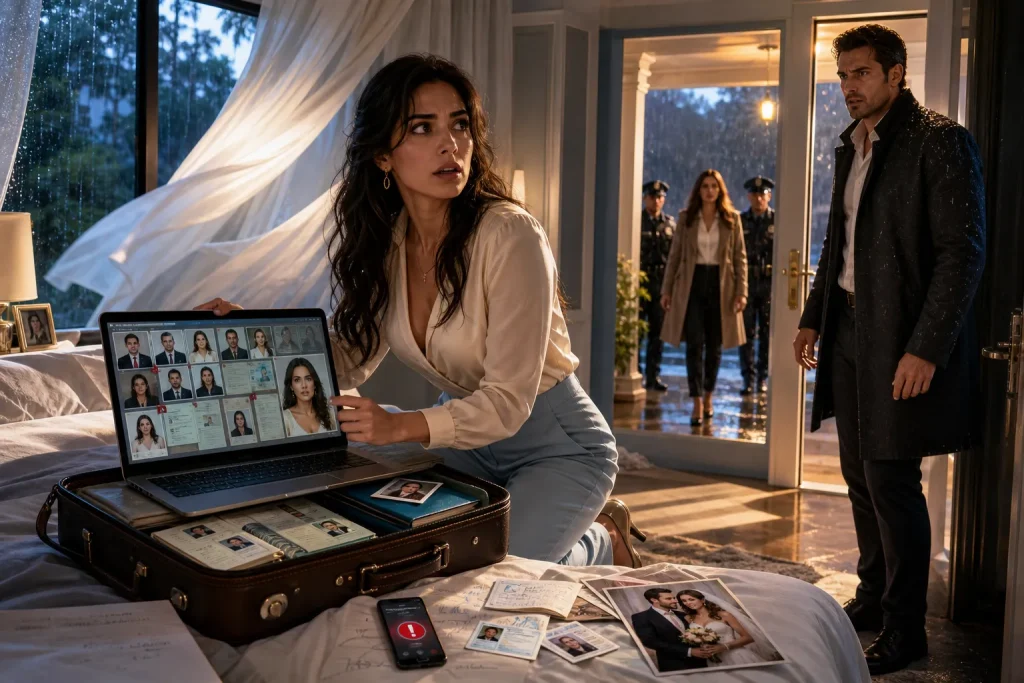
Elena found the laptop inside a locked suitcase beneath her husband’s winter coats.
Álvaro was supposed to be away until morning. The house was silent except for rain tapping the bedroom windows.
The computer was already awake.
Its screen displayed dozens of profile photographs—men and women of different ages—each paired with a name, occupation, address, and bank balance.
Some faces were familiar. Elena recognized a local teacher reported missing the previous year and a widower who had recently lost his savings to an online romance.
Then she found her own photograph.

ELENA VARGAS—STAGE FOUR.
Her hands shook as she opened a document titled “Progress Notes.”
Stage One: isolate her from friends.
Stage Two: redirect mail and passwords.
Stage Three: document instability.
Stage Four: obtain signature, close identity, disappear.
For months, Álvaro had told relatives that Elena was forgetful. He moved her medication, canceled appointments, and insisted she imagined conversations. She had begun doubting herself.
The laptop proved every “mistake” had been planned.
At the bottom of the file was tomorrow’s date and one final instruction:
MIDNIGHT—ELENA ENDS. EVA BEGINS.
The front door unlocked downstairs.
Álvaro had come home early.
Elena closed the laptop but did not return it to the suitcase. Instead, she pressed the emergency button on her phone, sending her location and a silent recording link to her friend Anna.
Footsteps climbed the stairs.
Álvaro appeared in the doorway, rain shining on his coat. His eyes moved from Elena to the computer.
“You should not have opened that.”
“Who is Eva?” Elena asked.
He smiled, but the warmth she once loved was gone.
“A client.”
Elena turned the screen toward him. Eva’s profile used Elena’s photograph altered with different hair, glasses, and an invented history. Bank accounts had already been created in that name.
Álvaro claimed he designed fictional identities for security testing. Elena opened another folder containing scanned passports, marriage certificates, insurance policies, and private messages from victims who believed they were speaking to real people.
The male and female profiles were not Álvaro’s secret lives. They were masks he sold.
He operated a network that stole personal histories, built convincing online identities, and used them to manipulate lonely victims. Marriage had given him access to Elena’s clean financial record, family trust, and citizenship documents.
Stage Four meant transferring her assets, reporting her missing, and continuing under a new digital identity built from her life.
Álvaro stepped closer. “Give me the laptop, and we can solve this.”
“You mean erase it.”
“I mean protect you.”
Elena laughed once. It sounded unfamiliar, but strong.
“You spent two years protecting me from everyone who might have noticed what you were doing.”
Her phone vibrated inside her pocket. Anna had received the alert.
Elena needed time. She asked Álvaro why the missing teacher’s photograph appeared in the database.
His answer exposed him.
“She was never supposed to contact the police.”
He froze as he realized the phone was recording.
Sirens approached outside.
Álvaro grabbed the suitcase and ran toward the back stairs, but Anna had arrived with two officers and blocked the garden exit. He surrendered without a struggle.
Investigators copied the laptop before its remote-deletion program activated. The files connected Álvaro to fourteen fraudulent identities, six emptied accounts, and three partners operating across Europe.
Among them were doctors, teachers, retirees, and parents whose trust had been coldly converted into carefully cataloged profit.
The missing teacher was found alive in another city. She had fled after discovering the scam but feared reporting it because Álvaro possessed forged messages that made her appear involved. The evidence cleared her.
Elena learned that her medication had never caused memory problems. Álvaro had moved objects, altered calendars, and repeated false stories until she distrusted her own mind. A therapist later gave the method a name: coercive control.
Naming it did not erase the damage, but it returned the blame to the person who deserved it.
Three months later, Elena entered the house with Anna and packed the last of Álvaro’s belongings for investigators. Beneath the suitcase she found an anniversary card he had never given her.
Inside, he had written, “You are the only person who truly sees me.”
Elena tore the card in half.
He had been wrong. She had seen only the character he created for her.
The real victory was not discovering whether Álvaro was the man she married or one of the identities on his screen.
It was remembering who Elena had been before he taught her to doubt herself.
She carried the empty suitcase outside, left it beside the evidence van, and walked into the morning without looking back.