Six Taxi Receipts in Dad’s Ledger
The first taxi receipt was folded into the page where my father recorded the price of galvanized nails.
I found it on a Thursday afternoon while I was helping him close the hardware store. The receipt was for a prepaid ride from the store to the adult learning center on the other side of town, then back again two hours later. The passenger name had been left blank.
“Do you use taxis now?” I asked.
My father, Elias, was counting the cash drawer. He glanced at the paper for half a second before taking it from me. “Sometimes people need a ride.”
“What people?”
“People who don’t drive.”
That was the kind of answer he had started giving since my mother died: technically complete and practically useless.
For most of my life, my father had been the person who noticed everybody else’s problems before they became emergencies. He replaced porch rails for widows who could not afford contractors, kept spare keys for three neighboring shops, and once drove ninety miles at midnight because my brother had locked himself out of a rental car. After my mother died, that competence became the reason my brother and I worried about him. He was seventy-one, living alone above the store, skipping meals when business was busy, and insisting that grief had not altered him at all.
My brother Daniel wanted him to retire. I wanted something less dramatic: regular dinners, a medical checkup, and an agreement that he would tell us if he needed help. My father interpreted both proposals as an attempted takeover.
Then he began missing Sunday dinner.
The first time, he said inventory had run late. The second time, he texted that a customer needed something delivered. The third time, he did not answer until nearly nine.
That was why the taxi receipt frightened me. Not because taxis were suspicious, but because my father had spent forty years mocking the idea of paying someone to drive a distance he could walk in twelve minutes.
A week later I found another receipt. Same company. Same destination. Same two-hour gap.
I did what worried adult children often call “checking” when they know perfectly well they are snooping. I opened the old green ledger beneath the register and looked backward through the previous month.
There were six receipts.
I pictured cardiology appointments, physical therapy, some diagnosis he had decided to handle alone. The adult learning center shared a parking lot with a small clinic, and that coincidence became evidence in my head almost immediately.
That evening I called Daniel.
“Don’t confront him yet,” he said. “He’ll just get defensive.”
“He already is defensive.”
“Then we need facts.”
Daniel lived three hours away and had recently become very interested in remote solutions to our father’s independence. Grocery delivery. Automatic bill pay. A camera over the back entrance of the store. He had even mailed Dad a smartwatch with fall detection.
Dad returned it unopened.
“I’m not a package you can track,” he had said.
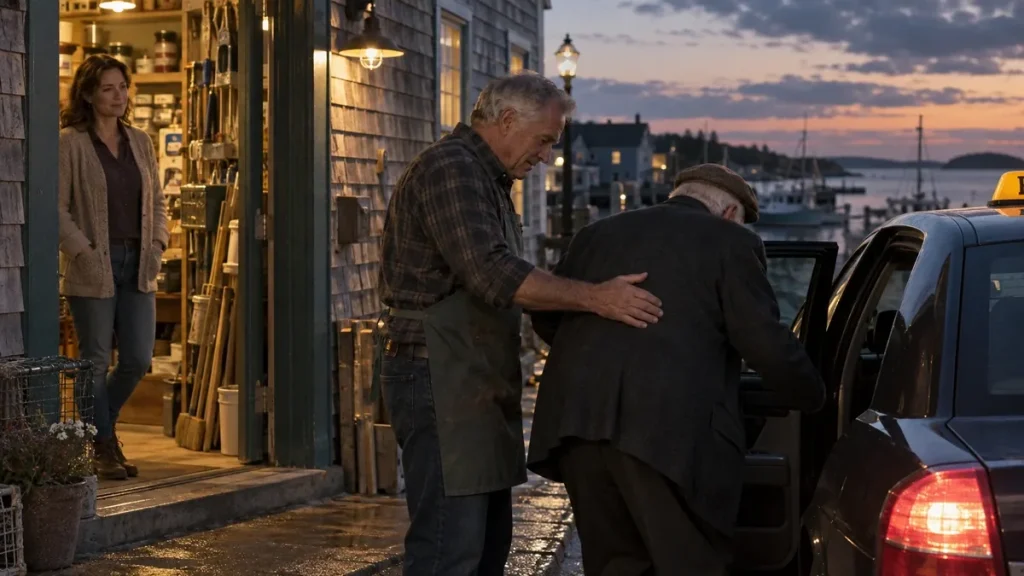
The next Tuesday, I left work early and parked across from the hardware store at five-thirty. I felt ridiculous within minutes. My father locked the front door at six, turned off the window sign, and came outside carrying a paper bag from the bakery next door.
A taxi pulled up.
Dad did not get in.
An older man came out of the side alley beside the store. I recognized him only after he reached the curb. His name was Mr. Alvarez. He had worked for my father when I was a child, first as a delivery driver and later behind the counter. He had retired years ago after his eyesight became too poor for driving.
Dad handed him the bakery bag, opened the taxi door, and said something that made both men laugh.
Then the taxi drove away without my father.
I sat in my car long enough for the shame to arrive.
The next morning I went into the store before opening.
“You followed me,” Dad said before I had finished my first sentence.
“I didn’t follow you. I waited across the street.”
“That distinction should make you feel much better.”
“I thought you were sick.”
He put down the box cutter he was using and looked at me properly. His irritation changed, but it did not disappear.
“Why would you think that?”
I told him about the receipts and the missed dinners. I told him about the clinic near the learning center. I told him Daniel and I were not trying to invade his life. That last part sounded weak even to me.
Dad leaned against the counter.
“Luis never learned to read well,” he said.
I knew Mr. Alvarez had left school young, but I had never understood what that meant in the daily architecture of his life. My father explained that when Luis had worked at the store, he memorized product locations, package colors, common invoices, even customers’ usual orders. He could read enough to get by, but forms and long instructions were difficult. His wife had handled most paperwork at home. She had died the year before.

“He signed up for evening classes in January,” Dad said. “Then he stopped going because the bus route changed. Taxi money is cheaper than losing the nerve to try again at seventy-four.”
“Why hide it in the ledger?”
“I wasn’t hiding it. That’s where I keep receipts.”
“Why didn’t you tell us?”
He gave me the look I had inherited and disliked seeing used against me.
“Because it wasn’t your story to inspect.”
I started to argue that we had been worried about him, but he raised a hand.
“You and Daniel think worry gives you a key to every locked drawer.”
“That’s not fair.”
“Isn’t it?”
He walked to the coffee machine in the back and poured two cups. He placed mine on the counter without asking, the same way he had since I was twenty.
“You know why I missed dinner?” he asked.
“Because of Mr. Alvarez?”
“Once. The other times I went fishing with Tom and Reggie.”
I stared at him.
“You hate night fishing.”
“I used to hate it. Your mother hated it more, so I had a good excuse not to go. Turns out I like sitting somewhere nobody asks whether I’ve taken my blood pressure.”
I laughed despite myself.
Then he said, “You children are very kind. But lately your kindness has started coming with forms.”
That landed harder than anger would have.
I thought about the spreadsheet Daniel had made for Dad’s medications even though Dad took only two pills. The meal-delivery trial I had arranged without asking. The way I checked the refrigerator whenever I visited, as if I were a health inspector. Each act had seemed small. Together they had apparently become a fence.
“What do you want us to do?” I asked.
“Ask.”
“That’s it?”
“Ask before helping. Believe my answer unless I give you a reason not to. If I fall apart someday, you can reorganize my life with great enthusiasm.”
“And until then?”
“Have dinner with me because you want dinner with me.”
Daniel was less pleased with this arrangement when I explained it. He pointed out, correctly, that independence can become denial without warning. Dad admitted, reluctantly, that this was true. After one tense three-way call, they negotiated two concessions: Dad would schedule the checkup he had postponed, and he would give both of us the name of the attorney who held his medical documents.
In return, Daniel removed the idea of installing a camera from future discussion.
As for Mr. Alvarez, I never asked about his classes. Dad volunteered an update months later.
“Luis read me an entire city notice yesterday,” he said, pretending to examine a shipment of hinges. “Complained about the grammar.”
“Sounds dangerous.”
“Education often is.”
On Sundays, Dad still occasionally misses dinner. Sometimes he tells us where he is going. Sometimes he says only that he has plans.
I have learned not to ask for proof.
A few weeks after our argument, I was helping at the store when another taxi receipt slipped from the green ledger. I picked it up, looked at the date, and tucked it back between the pages.
My father noticed.
He said nothing. Neither did I.
Then he pushed a box of new inventory toward me and asked if I wanted to stay for pizza after closing.
This time, I understood that an invitation was not the same thing as an obligation.