The Message Waiting on Her Mother’s Phone
Clara found her mother’s old phone message while taping the last box shut in the bedroom.
The phone began to vibrate inside the bedside drawer.
The sound startled her. The phone was an old gray model with a cracked corner, disconnected years ago and forgotten beneath a stack of pharmacy receipts. Clara had found it twenty minutes earlier and plugged it in only to see whether it held any photographs worth saving.
No one should have been able to reach it.
The screen displayed a notification from an unsaved number. Not a new message, she realized, but an old one restored when the phone connected to the house Wi-Fi.
Sent four months earlier—two days before Evelyn died.
“She deserves to know what really happened. I won’t keep covering for you.”
Clara read it twice.
Her mother’s name did not appear, but there was no mistaking the accusation. The message had also been opened.
Evelyn had seen it and said nothing.
Clara sat on the bare mattress. Around her, pale rectangles marked the places where framed photographs had hung. Her brother, Nathan, had taken most of them home that morning. Clara had kept only a few: school portraits, a picture of Evelyn laughing beside a supermarket birthday cake, and one photograph of Clara with her father before his fatal heart attack.
She pressed the number and held the phone to her ear.
The call rang once before someone rejected it.
Clara tried again. This time it went directly to voicemail.
“This is Clara Bennett,” she said after the tone. “You messaged my mother. If that sentence was meant for me, call me back.”
The phone contained almost nothing else. Evelyn had deleted most of her messages, and the photo gallery began only six months before her death. Clara was about to put it down when she noticed a conversation filed under the same number.
There were no words in the thread, only four photographs.
The first showed Evelyn in her thirties, standing outside a narrow brick house Clara did not recognize. Her hair was unwashed, and she looked away from the camera.
In the second, Evelyn stood beside her younger sister, Ruth.
Clara had not seen her aunt since she was nine.
According to Evelyn, Ruth had left after a bitter argument and chosen not to contact the family again. Evelyn rarely offered more than that. Whenever Clara asked, her mother would straighten her shoulders and say, “Some people find it easier to leave than to repair what they damage.”
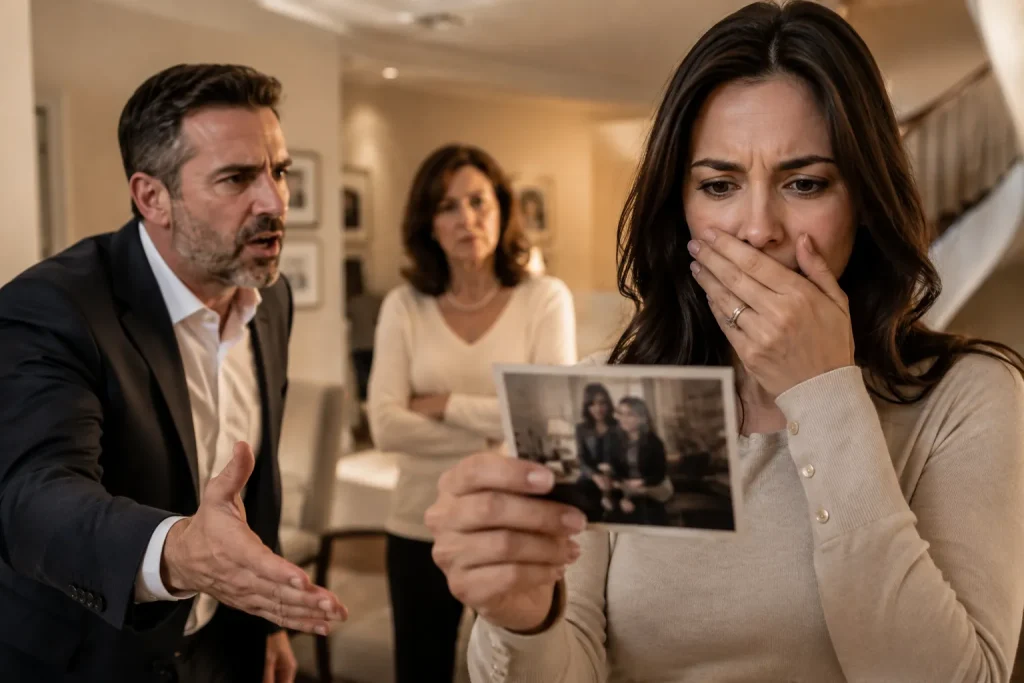
The third photograph showed Ruth kneeling beside a child in a red raincoat.
Clara enlarged the image.
The child was herself.
She appeared to be eight or nine, but Clara did not remember the coat, the brick house, or the white dog resting its head against her knee. On the back of the printed photograph, someone had written a date and three words:
Don’t tell Clara.
The date belonged to a year Clara remembered only in scattered pieces. Her father had died that January. She remembered returning to school, Evelyn burning toast every morning, and Ruth disappearing sometime before summer.
Nothing about living in another house.
The fourth photograph showed Clara asleep on a sofa beneath a knitted green blanket. Ruth sat on the floor beside her, reading a paperback under a lamp.
Clara’s phone rang in her pocket.
“Clara?” a woman asked when she answered.
The voice was older than Clara remembered, but its careful rhythm was familiar.
“Aunt Ruth?”
A pause followed.
“I hoped your mother would tell you herself.”
“Tell me what?”
“I don’t want to do this over the phone.”
“You sent her that message. You sent photographs of me in a house I don’t recognize. You don’t get to be cautious now.”
Ruth exhaled slowly. “The house was mine. You lived there for eleven months.”
Clara stood so quickly that her knee struck the drawer.
“That’s not possible.”
“After your father died, Evelyn needed treatment. I looked after you while she was in a residential recovery program.”
Clara walked into the hallway, as if another room might make Ruth’s words less absurd.
“My mother was never in a recovery program.”
“She became dependent on the medication she was prescribed after her back surgery. Your father managed things for a while. When he died, she stopped managing.”
“No.”
“You were eight. We told you she was working with doctors because she was exhausted. That part was true.”
Clara pressed her palm against the wall. A memory surfaced without warning: Ruth cutting the crusts from toast; the white dog scratching at a kitchen door; Clara waiting beside a window while rain rolled down the glass.
“Why don’t I remember living with you?”
“You remember some of it. You just weren’t given the words to connect the pieces.”
Clara looked toward the bedroom. Evelyn’s closet stood open, its hangers tapping together in the draft.
“And when she came home?”
“She asked me never to tell you. She was afraid you would watch her for signs that she might fail again.”
“So you vanished?”
“Not immediately.”
Ruth’s answer carried enough tension to stop Clara.
“What happened?”
“I kept notes while you were with me—appointments, medication changes, days your mother called, days she couldn’t. Her doctor suggested it. Evelyn found the notebook after she returned.”
“She thought you were spying on her.”
“She thought I was preparing to take you.”
“Were you?”
Ruth did not answer at once.
“I had spoken to a family solicitor,” she said. “Your mother had missed two appointments, and I was frightened she wasn’t ready. I wanted to know what would happen if she relapsed.”
Clara closed her eyes.
“So she wasn’t imagining it.”
“No. But I never filed anything. I told Evelyn I would return you as soon as her doctor believed she was stable, and I did.”
“Then why did she cut you off?”
“Because during the argument, I said something cruel. I told her you had been safer without her.”
The admission was quiet and unpolished. Ruth did not excuse it.
“I regretted it before I reached my car,” she continued. “But regret doesn’t make a sentence disappear. Evelyn told me never to come back.”
“And you listened for fifteen years?”
“I wrote. She returned the letters. When you turned eighteen, I found you online and nearly contacted you. Then I imagined arriving with a secret that could humiliate her and force you to choose between us.”
“You made that choice for me.”
“Yes.”
Clara sank onto the hallway floor. “Why send the message now?”
“Your mother called me last winter. Her voice was weak. She said she had kept the phone because it contained the only copies of those photographs.”
“She asked you to send them?”
“She asked me to wait. Then she stopped answering. I lost patience and sent the message.”
“And the warning on the photograph?”
“Evelyn wrote it. She mailed the pictures back to me after our argument.”
Clara could hear traffic behind Ruth, then the ticking of a turn signal.
“Where are you?” she asked.
“Outside your mother’s house.”
Clara went to the front window. A blue hatchback was parked across the street. A silver-haired woman sat behind the wheel with both hands resting on it.
“You came here before calling me?”
“I came here three times this month,” Ruth said. “I never managed to get out of the car.”
Clara opened the front door but remained behind the threshold.
Ruth stepped from the hatchback. She was shorter than Clara remembered. Age had softened her face, though her mouth still tightened at one corner when she was nervous.
Neither woman moved closer.
“You look like your father when you’re angry,” Ruth said.
“Don’t start with that.”
“You’re right. I’m sorry.”
The apology, immediate and undramatic, unsettled Clara more than an excuse would have.
Ruth retrieved a biscuit tin from the car. Inside were Evelyn’s returned letters, still sealed, along with the green blanket from the photograph. The wool had faded, and several squares had been repaired with mismatched thread.
“I thought you might want these,” Ruth said.
Clara lifted one envelope. It was addressed to Evelyn in Ruth’s narrow handwriting and stamped twelve years earlier.
“You kept every one?”
“I couldn’t decide whether keeping them was hopeful or pathetic.”
Clara almost smiled, then resented herself for it.
They carried the tin into the kitchen. Ruth stopped beside the counter and touched a small burn mark near the kettle.
“She did that making caramel,” she said. “Your father insisted the pan was ruined. Evelyn used it for another twenty years out of spite.”
Clara knew the story, but not Ruth’s place in it.
For the next hour, she asked questions. Ruth answered without trying to make herself look generous. She admitted that she had been impatient with Evelyn’s recovery and too confident that competence made her right. She also described the sister Evelyn had been before grief and medication narrowed her world: untidy, competitive, funny at funerals, and incapable of following a recipe.
Nathan arrived while Ruth was speaking.
He recognized her immediately and stopped in the doorway.
Clara told him what she had learned. He listened with his arms folded, then turned on Ruth.
“You should have told us.”
“I should have found a way,” Ruth said.
“That’s not an answer.”
“No. It’s only the truth.”
Nathan refused to stay. Before leaving, he told Clara not to hand a stranger a place in the family simply because their mother was gone.
Ruth flinched but did not argue.
After the door closed, Clara found herself defending Nathan. “He spent the last six months taking her to appointments. He’s tired.”
“He has every reason to distrust me.”
“So do I.”
“I know.”
Ruth stood and reached for her coat. Clara did not stop her.
That evening, alone again, Clara opened the old phone and searched its audio files. Most were accidental recordings of rustling fabric and television programs. The last file, dated the night Evelyn received Ruth’s message, was forty-seven seconds long.
Evelyn’s voice emerged thin but recognizable.
“Ruth, I have tried to answer you six times.”
There was a long silence.
“Clara thinks you left because I let her think it. At first I needed someone to blame. Later, I didn’t know how to correct the story without telling her the rest.”
Another pause followed, broken by Evelyn clearing her throat.
“You were wrong about some things. You were right about others. I’m still angry, which is inconvenient.”
Clara heard the faint creak of her mother’s bed.
“If I cannot tell her, give her the photographs. Don’t make yourself innocent. Don’t make me a monster.”
The recording ended there.
Clara sent the file to Nathan. He did not reply.
Then she called Ruth.
“I found something,” Clara said.
“I can come back another day.”
“No. Come now. Bring the letters.”
Twenty minutes later, Ruth returned. Clara placed the phone between them on the kitchen table and pressed play.
When Evelyn’s voice filled the room, Ruth gripped the edge of her chair. She did not cry until the final sentence. Even then, she wiped her face quickly, as though tears were another kind of claim she had not earned.
Clara opened the oldest envelope but did not unfold the letter.
“I’m not ready to forgive either of you,” she said.
Ruth nodded.
“But I want to know what happened during those eleven months.”
“I can tell you.”
Clara pushed the biscuit tin to the center of the table.
“Start with the white dog.”