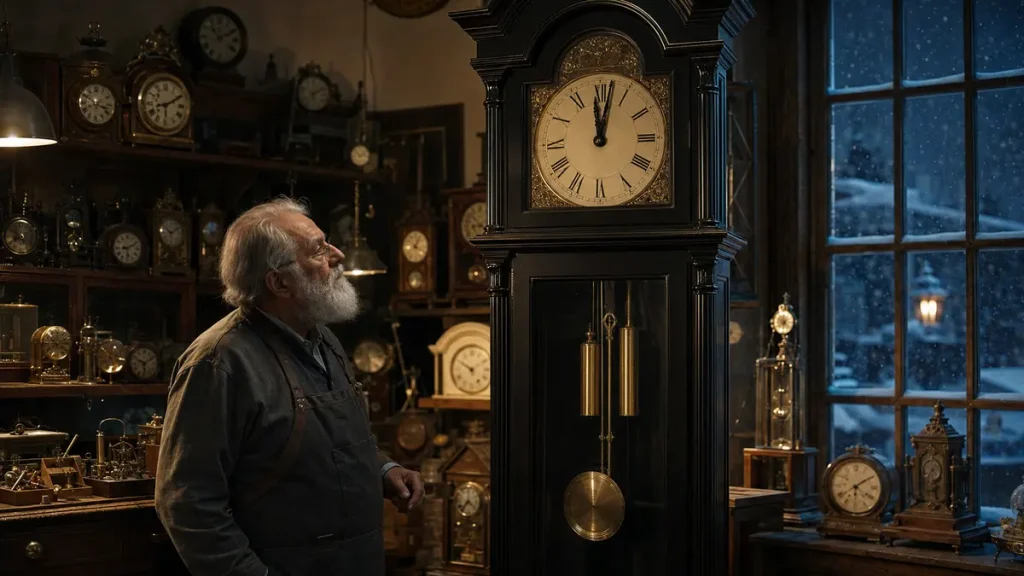
The Clockmaker Who Would Not Fix Midnight
Every clock in Emil Varen’s shop kept perfect time except the tall black one in the corner.
It stopped at 11:57.
The minute hand never moved. The pendulum hung still. No dust touched its polished case because Emil cleaned it every morning before opening the shop.
Customers often asked whether it was for sale.
“No.”
“Can it be repaired?”
“Yes.”
“Then why don’t you repair it?”
“Because it is not broken.”
That answer satisfied nobody, especially Mara Lin, who operated the flower shop next door. She had watched Emil unlock his door at precisely 8:28 each morning for seven years. He ate lunch at 12:12, watered one plant at 4:05, and closed at 6:31.
For a man devoted to time, he treated 11:57 like a forbidden room.
One winter evening, a burst pipe flooded Mara’s shop. Emil helped carry flower buckets into his workshop before the water reached them. By the time the plumber arrived, snow had blocked the road and both shops were without heat.
They waited beside a small electric heater among hundreds of clocks.
At eleven fifty, Emil stood.
“I must go.”
“In this storm?”
“Especially in this storm.”
He put on his coat and left through the rear door, telling Mara to lock up whenever the plumber finished.
At 11:56, the shop sounded like rain made of gears. Mantel clocks clicked. Pocket watches whispered. A brass carriage clock chimed the quarter hour late.
Then the tall black clock began ticking.
Mara turned.
Its pendulum moved once.
Twice.
The minute hand advanced to 11:58.
👇
At 11:59, every other clock stopped.
Silence filled the shop.
From inside the black clock came the faint sound of a woman’s voice humming.
Mara stepped closer. The door in its wooden case was locked, but warm light showed through the edges. The humming continued for less than a minute.
At midnight, the light vanished.
All the clocks resumed at once.
The black clock’s hands returned to 11:57.
The following morning, Mara confronted Emil.
He did not deny what happened.
Eighteen years earlier, the clock belonged to Emil’s wife, Celeste, a theatre pianist who practiced late into the night. On the final evening of her life, she left rehearsal during a winter storm and called the shop from a public telephone.
“Wait three minutes,” she told him. “I am almost there.”
The call ended at 11:57.
Celeste never arrived. Her taxi slid from an icy bridge shortly before midnight.
For months, Emil dismantled and rebuilt the clock, convinced its sudden failure had caused him to miss some warning. Each time he repaired it, the hands stopped again at 11:57.
Then, on the first anniversary of Celeste’s death, it ticked for three minutes while the rest of the shop went silent. Emil heard her humming the melody she always played while searching for her keys.
“You hear her every year?” Mara asked.
“Only if I am not here.”
The first years, Emil remained beside the clock. Nothing happened. When grief finally drove him to spend the anniversary elsewhere, the clock moved and a neighbor heard the humming.
It seemed Celeste would return only to an empty room.
“So you leave,” Mara said.
“I give her the three minutes she asked for.”
Mara wanted to say the mechanism had a logical explanation. She wanted to inspect hidden speakers, temperature-sensitive springs, or a timer concealed in the case.
Instead she asked where Emil went during those three minutes.
“The bridge.”
Each anniversary, he stood at the place where Celeste died while her voice returned to the shop where she had been heading.
They had spent eighteen years missing each other by the same distance.
The next winter, Mara prepared before the anniversary. She placed white winter roses beside the black clock and closed both shops early. At eleven thirty, she handed Emil two cups of coffee.
“We are not going to the bridge,” she said.
“Then she will not come.”
“You have waited there eighteen times. Perhaps waiting is the part that needs repairing.”
They walked to the small theatre where Celeste once played. The building had become a cinema, but an old upright piano remained in the lobby.
Mara had arranged for the doors to stay open.
At 11:57, Emil sat before the piano. He had not played since his wife’s death. His first chord was wrong. The second was worse.
Then he found the melody Celeste used to hum.
Back at the shop, the black clock began to tick.
This time, the minute hand passed 11:58, 11:59, and midnight.
It did not stop.
The next morning, Emil found the winter roses scattered across the floor. The clock showed the correct time. Inside its case, the lock had opened by itself.
There was no hidden speaker. No recording. Only an old brass key and a folded sheet of music in Celeste’s handwriting.
At the bottom, she had written a line Emil had never seen:
Do not wait for me where the music ended. Play from the next measure.
Emil repaired the clock properly that afternoon.
Years later, customers still asked why its black case stood apart from the others.
“Was it difficult to fix?”
“No,” Emil said. “It was difficult to let it continue.”
The clock never stopped at 11:57 again.
But each winter, for exactly three minutes before midnight, the shop smelled faintly of white roses and someone could be heard humming behind the gears.
For more stories built around surprising reveals, browse our short stories with a twist.