The Photographer Who Never Took Faces
Gabriel Orsini photographed people for forty years without showing a single face.
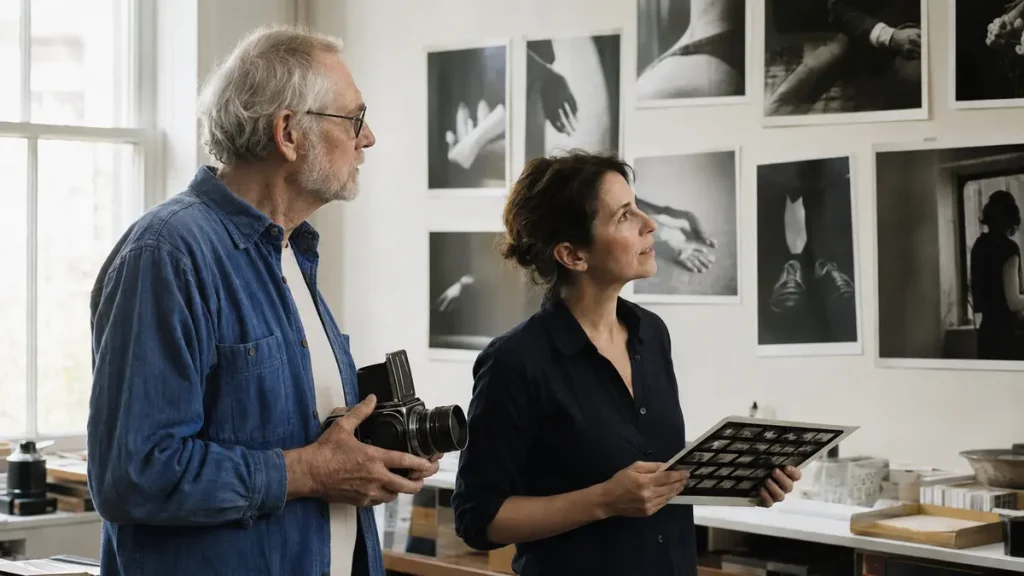
He photographed a violinist’s fingers after a concert, a nurse’s shoes at the end of a night shift, a bride’s hands holding her grandmother’s handkerchief, and a carpenter’s shoulders beneath a shirt covered in sawdust.
Critics called his work intimate. Museums called it unmistakable. Strangers stood before his photographs and invented entire lives for the people whose faces they could not see.
His daughter Mira called it hiding.
As a child, she begged him to take ordinary family pictures. Gabriel photographed her red boots in the snow, her schoolbag beside the door, and the braid her mother tied each morning.
“Just one of my face,” Mira said on her tenth birthday.
Gabriel lowered the camera.
“Your face changes every day,” he told her. “I am keeping what you will forget.”
Mira did not forgive this explanation.
When she became an adult, she studied exhibition design rather than photography. She spent her career arranging other people’s images on white walls. She and Gabriel spoke often but carefully, like people carrying full cups through a crowded room.
At seventy-three, Gabriel lost most of his sight within six months.
He continued taking photographs by sound and distance, but he could no longer develop them alone. He asked Mira to prepare one final exhibition.
“No title,” he said. “Choose the pictures after you see them.”
His archive occupied twelve metal cabinets. Each drawer contained negatives, contact sheets, dates, and brief notes: hands after apology, coat left on train, boy waiting outside music room.
Mira worked chronologically. She recognized her mother’s hands, her own childhood shoes, and the curve of Gabriel’s back reflected in a shop window. The absence of faces felt more deliberate with every drawer.
Then she reached a box marked DO NOT PRINT.
Inside was a contact sheet from 1987.
Eleven frames showed a hospital corridor, an empty cup, and a woman’s hand resting on a blanket.
The twelfth showed a face.
It was Gabriel’s younger brother, Luca.
👇
Mira knew almost nothing about him. Luca died before she was born. Gabriel said only that he had been ill and disliked photographs.
Yet in the image, Luca looked directly into the lens. He was thin but smiling. One hand was raised as though asking the photographer to wait.
On the back of the contact sheet, Gabriel had written:
The last photograph. The mistake I kept.
Mira carried it to her father.
Gabriel touched the paper’s edges. He did not need to see it.
Luca had spent his final months in hospital. Gabriel, then a young newspaper photographer, documented everything because the camera gave him something to do with fear. Luca allowed it on one condition: no photographs of his face.
“He did not want our mother to remember him sick,” Gabriel said.
On the last day, Luca changed his mind.
“Take one,” he told Gabriel. “But do not show it until you can look without seeing the illness first.”
Gabriel took the photograph.
He had never reached the day Luca described.
“Every time I looked, I saw the hospital,” he said. “So I began photographing people without faces. I thought if I removed the expression, I could not misunderstand the person.”
His famous style had not begun as an artistic philosophy. It began as a brother’s failure to keep looking.
Mira placed the contact sheet on the table.
“He is smiling.”
“I know.”
“No. You remember that he was smiling. That is different from looking.”
Gabriel turned toward the window, where he could still distinguish light from shadow.
For the exhibition, Mira selected thirty photographs. She arranged them not by year but by gesture: hands reaching, hands releasing, feet arriving, coats departing, objects held and abandoned.
At the center, she left one empty space.
Gabriel attended the installation with a white cane. Mira guided his hand along the wall until he felt the gap.
“What goes here?” he asked.
“You decide.”
For two days, the space remained empty.
On the morning before opening, Gabriel asked Mira to print Luca’s portrait.
She made it small, no larger than a page from a family album. They hung it without a label.
At the exhibition, visitors moved through decades of faceless lives and stopped at Luca. Some were startled. Others leaned closer.
Gabriel stood nearby, listening.
A child asked why this one photograph was different.
Mira waited for her father to answer.
“Because he asked to be seen,” Gabriel said.
The exhibition was titled What We Keep. It became Gabriel’s most visited show, but the reviews mattered less than what happened afterward.
Mira brought a camera to her father’s apartment. She placed it in his hands and sat opposite him.
“Take my picture.”
“I cannot focus.”
“Neither could I when I was ten.”
Gabriel listened to her breathing and raised the camera. The first frame cut off the top of her head. The second was blurred. In the third, Mira was laughing.
It was the only clear portrait he ever made of his daughter.
She kept it beside the photograph of her red boots.
After Gabriel died, museums requested the Luca portrait for retrospectives. Mira refused to separate it from the rest of the exhibition.
“It is not the exception,” she explained. “It is the reason.”
Years later, when students asked why Gabriel’s photographs felt so recognizable without faces, Mira gave them his old answer, amended by one sentence.
“A face changes every day. He kept what people might forget—and, once, what he had been afraid to remember.”