The Silent Piano in Apartment 6B
Every evening at 8:20, one piano note sounded above Mina Rahal’s bedroom.
Not a song. Not a chord. Just the same low note, held for two seconds and released.
Apartment 6B was supposed to be empty.
Its owner, Mrs. Varga, had moved into a care home after breaking her hip. Her furniture remained upstairs, including an upright piano too heavy to remove, but nobody had lived there for five months.
Mina’s father blamed old pipes.
“Pipes do not play B-flat,” Mina said.
At thirteen, she had studied piano long enough to identify notes and recently quit long enough to resent them. Her mother had been her first teacher. After her mother died, every practice piece felt like a conversation with one side missing.
The note continued each evening.
At 8:19, Mina would sit on her bed and wait. At 8:20, B-flat sounded through the ceiling.
On the seventh night, she recorded it. On the tenth, she stood in the corridor outside 6B. The note sounded behind the locked door.
She told the building superintendent.
“Mice,” he said.
“Mice do not keep time.”
“City mice do.”
On the fourteenth evening, Mina borrowed the spare key while the superintendent was distracted by a leaking washing machine.
At 8:18, she entered Apartment 6B.
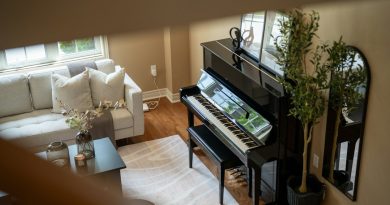
Dust covered the furniture. Moonlight rested across the piano keys. Mina checked every room, every window, and the space beneath the piano.
Nobody was there.
At 8:20, the B-flat key moved by itself.
👇
Mina jumped backward.
Then she saw the thin metal rod connected to the key. It ran through a small hole in the wall beside the radiator.
On the other side lived Mr. Varga, Mrs. Varga’s younger brother.
He occupied Apartment 6A and rarely left it. Mina knew him only as the man who complained when delivery workers blocked the elevator.
She knocked on his door holding the end of the rod.
It took him several minutes to answer.
Mr. Varga was eighty-one, unshaven, and wearing a cardigan buttoned incorrectly. Behind him, the apartment was crowded with books and unopened mail.
“You found it,” he said.
Years earlier, when his sister still lived next door, the two apartments shared a peculiar evening ritual. Mrs. Varga taught piano lessons until eight. At 8:20, she played a B-flat. Her brother answered by tapping the heating pipe once.
It meant: Tea is ready.
After Mrs. Varga moved away, Mr. Varga built the rod so he could press the key from his apartment. He continued tapping the pipe afterward, although nobody answered.
“Why?” Mina asked.
“Because eight twenty still arrives.”
She understood more than she wanted to.
The next evening, the B-flat sounded. Mr. Varga tapped the pipe.
Mina sat at the piano and played the next note: C.
The tapping stopped.
After a moment, it came twice.
Mina played D.
They created a clumsy conversation—one note, one tap, another note. It was not music, but it was not silence either.
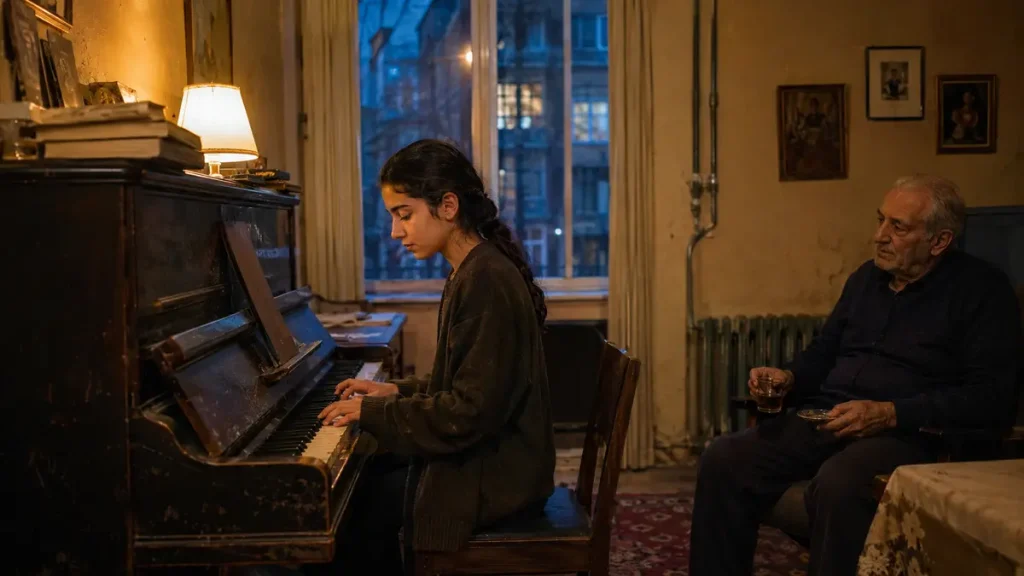
Soon Mina began visiting Apartment 6B at 8:15. Mr. Varga brought tea through the connecting balcony. He knew nothing about piano but had attended every recital his sister ever gave. Mina played scales while he offered useless criticism.
“That one sounded nervous.”
“It was F major.”
“F major needs confidence.”
Mina contacted Mrs. Varga at the care home. Her memory came and went, but when Mina described the B-flat, she laughed.
“My brother always made terrible tea.”
They arranged a video call at 8:20. Mina placed the phone on the piano. Mrs. Varga raised one hand from her chair and tapped the armrest after the note.
Mr. Varga cried so quietly that Mina pretended not to notice.
Winter arrived. Mina returned to lessons, this time with a teacher who had never known her mother. She practiced in 6B because the old piano sounded warmer than the electric keyboard downstairs.
For a school recital, she composed a short piece built around B-flat and the rhythm of two taps on a pipe. She called it Tea Is Ready.
Mr. Varga sat in the front row. Mrs. Varga watched by video. Mina’s father, who had not heard his daughter perform since his wife’s death, sat beside them holding his breath.
The piece began with one isolated note.
Then another instrument answered.
By the end, the melody passed between both hands, never leaving either side alone for long.
Afterward, Mina’s father asked her to play it again at home.
“Tomorrow,” she said.
It was the first time music had felt like a future appointment rather than a memorial.
When Mrs. Varga died the following spring, Mr. Varga removed the metal rod. At 8:20, he and Mina sat beside the piano without playing.
The silence lasted one minute.
Then he tapped the wood twice.
Mina played B-flat.
Years later, Apartment 6B became a small music room for children in the building. The superintendent claimed this had always been his plan. Nobody believed him.
Above the piano, Mina placed a simple card:
IF YOU HEAR ONE NOTE, ANSWER WITH ANOTHER.
Every evening at 8:20, someone did.