The Woman Who Painted Every Door Yellow
Nadiya Sol painted her front door yellow because sometimes she forgot how to find home.
She knew her address. She knew the route from the train station. But during panic attacks, Alder Row became a tunnel of identical gray houses. Numbers blurred. Her breathing shortened. Every doorway looked like the wrong doorway.
So one Saturday morning, she bought a tin of sunflower-yellow paint.
Her landlord objected before the first coat dried.
“The agreement says neutral colors.”
“Sunlight is neutral,” Nadiya replied.
“Sunlight is not paint.”
She promised to restore the original gray when she moved out.
For the first time in months, Nadiya returned from work without checking house numbers. The yellow door appeared at the end of the street like a small lamp.
It did not cure her anxiety. It gave anxiety one less decision to make.
The first neighbor to comment was six-year-old Benji from Number 12.
“Your house is awake,” he said.
His own door was brown. Together they decided it looked sleepy.
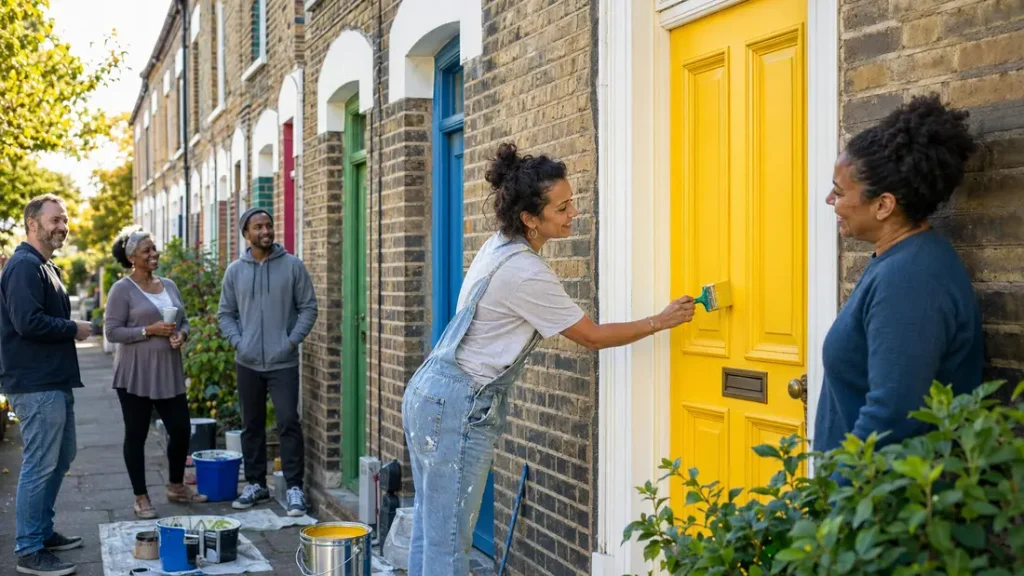
Mrs. Adeyemi at Number 14 wanted a green door but could not climb a ladder. Nadiya offered to paint it. Mr. Frost at Number 16 requested dark blue, then changed his mind four times. The twins at Number 9 chose coral and argued over which twin had invented coral.
By June, seven doors had changed color.
People who had lived side by side for years began borrowing brushes and learning one another’s names. Nadiya kept leftover paint in labeled jars and used it to repair scratches. Benji appointed himself Color Inspector and wore a paper badge.
Then an anonymous complaint reached the neighborhood association.
All doors had to return to approved gray within fourteen days.
👇
The letter referred to “visual disorder” and “reduced architectural consistency.”
Nadiya stood outside with the notice in her hand. The yellow door behind her seemed suddenly childish.
“We knew the rules,” Mr. Frost said.
“Rules can be changed,” Mrs. Adeyemi replied.
The association meeting took place in a windowless room painted beige. Nadiya planned to explain accessibility, panic attacks, and the value of recognizable landmarks. When her turn came, her heart raced so violently that she could not stand.
Benji stood instead.
“Gray is also a color,” he said. “Why is it the boss of all the other colors?”
The committee chair did not have an answer suitable for a six-year-old.
Other neighbors spoke. Mrs. Adeyemi explained that painting her door had brought people to her porch for the first time since her husband died. Mr. Frost admitted he had chosen blue because it reminded him of the fishing boats where he grew up. The twins presented a petition containing sixty-three signatures and several juice stains.
The complaint had come from a property investor who owned three empty houses and worried that color would make the street look “informal.”
The residents proposed new guidelines: safe exterior paint, maintained surfaces, and freedom of color.
The committee postponed the decision.
That weekend, Nadiya found a gray paint tin outside her door. For a moment, she thought the landlord had delivered it.
Then she read the note taped to the lid:
For the empty houses. Gray deserves a choice too.
Inside the tin was not gray paint but silver.
The anonymous donor was Mr. Frost.
Neighbors painted small silver stars on the boarded doors of the empty houses. They planted flowers in abandoned pots and removed rubbish from the steps. The street became colorful without becoming careless.
Local newspapers published photographs. Visitors came to see Alder Row, which embarrassed everyone except Benji. A community arts group offered to help draft the new policy.
The association approved it by one vote.
Nadiya did not paint every door yellow, despite what people later claimed. She painted only her own yellow. The others became green, blue, coral, red, violet, white, and once—after an unfortunate online order—glow-in-the-dark lime.
But years later, residents still called her the woman who painted every door yellow because her door had given them permission to imagine their own.
Her panic attacks did not disappear. Some evenings the street still narrowed around her. On those days, the yellow door remained easy to find.
More importantly, there was usually someone on a blue, green, or coral porch who recognized her before she reached it.
When Nadiya eventually bought the house, the landlord sent a final message.
“You no longer need to restore the original color.”
She wrote back:
“I know.”
Then she opened a fresh tin of sunflower yellow and gave the door another coat.