The Mountain Café That Opened Only in Fog
The café appeared only when fog covered the mountain road.
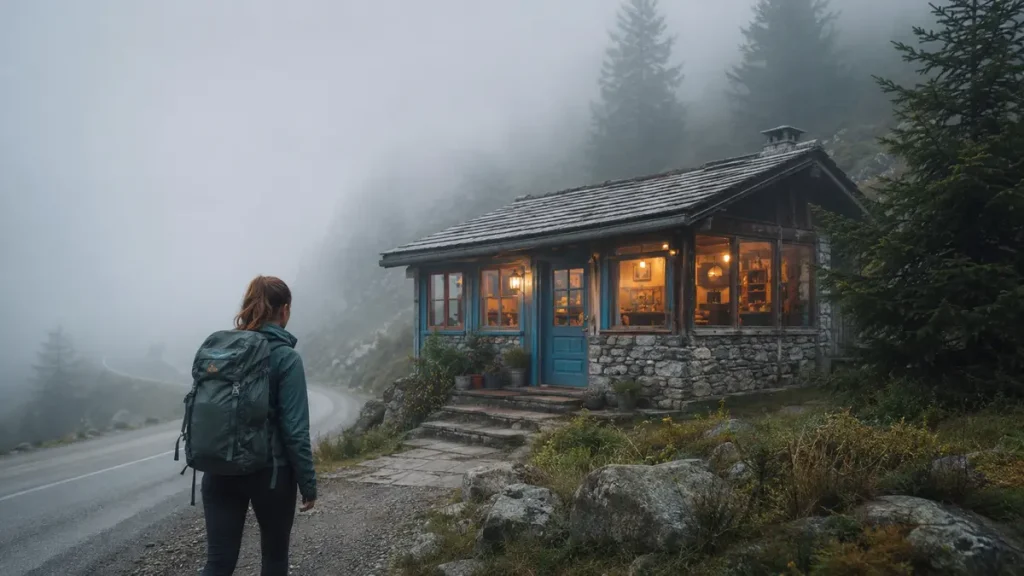
On clear days, travelers saw a stone wall, three pine trees, and a view of the valley. During heavy fog, a wooden building stood beside the same bend with amber windows and a blue door.
Inside, a woman named Anya served lentil soup, bread, and tea with mountain thyme.
She had no menu, no telephone, and no interest in money.
“You can pay next time,” she told everyone.
There was never a next time.
Lina Moravec found the café after losing the hiking trail in October. Her map was wet, her phone had no signal, and darkness was arriving faster than expected. When she saw the windows, she assumed she had reached a village.
Anya opened the blue door before Lina knocked.
“Boots by the stove,” she said. “Soup first. Worry afterward.”
Three other travelers were inside: a truck driver whose engine had overheated, a couple who had missed the road to a wedding, and a shepherd searching for two goats. Nobody knew where the café came from.
Anya fed them and drew directions on a paper napkin. At nine, the fog lifted enough to reveal the road.
“What do I owe you?” Lina asked.
“Tell the next lost person to stop walking downhill after sunset.”
Lina followed the directions and reached her lodge safely.
The next morning, she drove back to thank Anya.
At the bend, she found only an abandoned stone foundation.
👇
She checked the distance twice. The three pine trees were there. So was the stone wall. The café was not.
At the nearest village, older residents knew the story.
Decades earlier, a café called The Blue Door stood along the old mountain road. Its owners, Anya and Petar, kept blankets and food for stranded travelers. One winter, Petar left to guide a lost family through a storm and never returned.
Anya continued operating the café until a landslide destroyed it.
“What happened to her?” Lina asked.
Nobody agreed. Some said she moved away. Others said she remained in the mountains.
The village baker laughed at the legend.
“Fog makes people see what they need.”
Lina showed him the paper napkin.
The drawing included an old shepherd path no longer shown on maps. At the bottom, Anya had written: Tell Milan his goats are near the eastern bell.
Milan was the shepherd Lina met in the café. That afternoon, villagers found his missing goats beside the ruined bell tower east of the road.
Lina became curious enough to be unreasonable.
She returned whenever fog was forecast. For six weeks, she found nothing. Then, on a December evening, amber light appeared between the pine trees.
The blue door opened.
“You again,” Anya said.
“You said I could pay next time.”
Lina carried groceries, candles, batteries, and a first-aid kit. Anya accepted the supplies but refused questions until after soup.
The café, she explained, did not belong to another world. It was a real wooden shelter built farther up the slope after the original café collapsed. During fog, Anya and several villagers moved portable lanterns and a blue door panel to make it visible from the dangerous bend.
“Why hide it in clear weather?”
“We do not hide it. In clear weather, people look at the valley instead of the trees.”
The mysterious café was partly illusion, partly geography, and mostly the work of people who preferred not to become an attraction.
Anya was not the original owner. She had been named after her.
Her grandmother was the lost child Petar rescued on the night he disappeared.
The family never learned exactly what happened to him, but they remembered the promise made by the café: nobody stranded on the mountain would face the fog alone.
“So you keep opening it?” Lina asked.
“Only when necessary.”
Lina began helping. She studied mountain rescue and learned the old paths. On foggy evenings, she carried bread to the shelter and checked the road markers. The café remained absent from maps because maps brought tourists, while the shelter existed for people in trouble.
Years passed. Safer barriers and emergency beacons were installed along the road. Fewer travelers became lost.
The café opened less often.
One spring, the village council proposed dismantling the shelter. Anya agreed.
“If it is no longer needed, that is success,” she said.
Before they removed it, fog descended unexpectedly. A school minibus stopped near the bend after a tire failed. Twelve children and their teacher followed the amber lamps to the blue door.
They ate every bowl of lentil soup.
The council voted to keep the shelter.
Today, travelers still tell stories about a café that appears from nowhere. They describe different owners, different rooms, and sometimes different food. Skeptics say exhaustion explains everything.
Lina never corrects either version.
When someone asks whether the café is real, she gives the answer Anya taught her:
“That depends. Were you lost?”