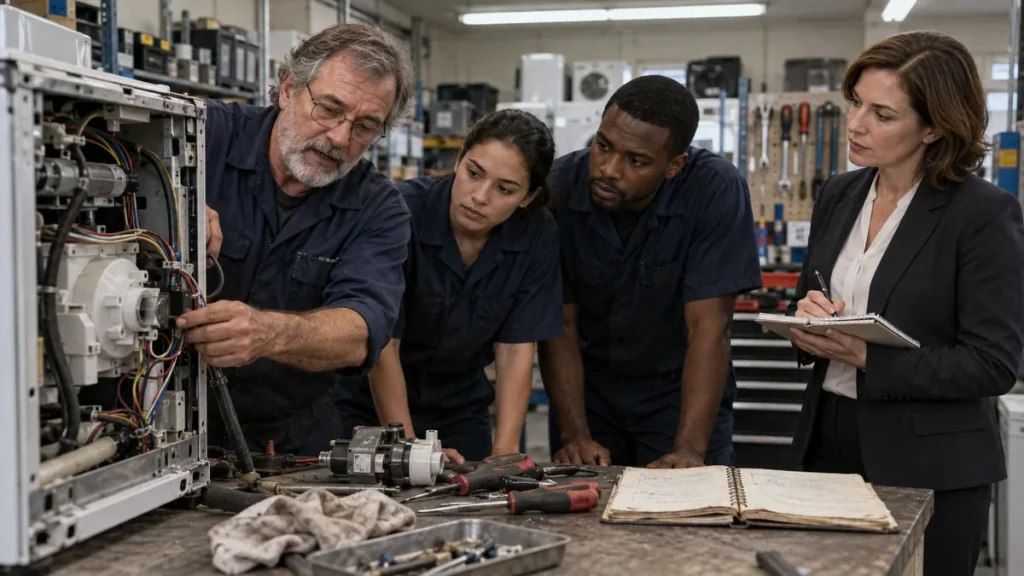
Martin’s Notebook Became the Company Manual
Martin Vale knew the refrigerator was going to fail again before the customer finished describing the noise.
“A soft click, then six or seven seconds of humming?” he asked.
The customer nodded. “Exactly. Your office said to check the rear vent first because the compressor can overheat when the condenser air path is blocked.”
Martin stopped with his hand inside his tool bag.
Those were his words.
Not approximately his words. Exactly his words, including “condenser air path,” a phrase nobody at Calder Appliance Repair used except Martin because he had written it years earlier in a spiral notebook he kept in the top drawer of his bench.
“Who told you that?”
“The woman who called yesterday. She was reading from some troubleshooting guide.”
By the time Martin returned to the service center, irritation had hardened into certainty.
The guide was his notebook.
For twenty-seven years Martin had repaired washers, refrigerators, dryers, ovens, and the occasional appliance so old that the manufacturer had disappeared. He had survived three owners, four scheduling systems, seven service vans, and more “modernization initiatives” than he cared to remember. What kept him valuable was not speed. Younger technicians were faster. It was the private library in his head: which discontinued hinge could substitute for another, which fault code lied, which model had wires that rubbed through behind the insulation after six winters.
Some of that knowledge lived in the notebook.
His new manager, Priya Desai, had arrived four months earlier with a laptop, color-coded dashboards, and a habit of saying “process dependency” when Martin would have said “someone needs to know what they’re doing.”
They were polite to each other in the way people become polite when they are saving their real opinions.
Martin went directly to her office.
“Did you copy my notebook?”
Priya looked up from her screen. “Good afternoon to you too.”
“Did you?”
She closed the laptop.
“I photographed several pages while you were out in June.”
He had expected denial. The admission made him angrier.
“You went into my drawer.”
“Your drawer wasn’t locked.”
“That’s not permission.”
“No,” she said. “It wasn’t.”
That answer disrupted the speech he had prepared on the walk from the parking lot.
“So you know it was wrong.”
“I know I should have asked. I also know that while you were out for two weeks, three technicians called you at home, customers waited an extra day because nobody could identify replacement parts, and one warranty claim was rejected because the documentation process existed only in your memory.”
Martin stared at her.
His absence in June had been caused by a minor surgery he preferred not to discuss. He had taken fourteen days off, his longest break in decades. His phone had rung constantly. He had answered it constantly too, partly because he wanted to help and partly because being needed reassured him.
“That’s not my problem,” he said.
Priya’s expression changed. “Actually, Martin, it is partly your problem. And partly mine. We built a department where one person’s memory became infrastructure.”
“So your solution was theft?”
“My solution was rushed and disrespectful.”
She did not say theft.
Martin noticed.
The next morning a printed document appeared on the shop floor: CALDER FIELD TROUBLESHOOTING GUIDE, version 0.4. It contained diagrams, checklists, and blocks of text from Martin’s notebook. His name did not appear anywhere.
That was the moment his anger changed shape.
Until then, he had been offended by the invasion of his drawer. Now he saw something larger. His knowledge had been converted from a private asset into company procedure, and once it became procedure, it could be taught to anyone.
For the first time, he wondered if Priya’s goal was to make him unnecessary.
He began watching the younger technicians. Elena had started carrying a printed checklist. Jonah no longer asked Martin which substitute gasket fit the older Weston models; he looked it up. Even the dispatcher had a quick-reference sheet for common customer questions.
Each improvement felt like a small subtraction from Martin himself.
Three days later, Priya asked him to meet with her and the regional director.
“Here it comes,” Martin told Elena.
“What comes?”
“My ceremonial thank-you before they replace me with a binder.”
Elena frowned. “Martin, you know the binder doesn’t fix anything, right?”
He ignored her.
The regional director, Alan, joined the meeting by video. Priya began with service delays, return visits, warranty denials, and training time. The numbers had improved since the guide was introduced.
Then Alan said, “Priya tells me most of this originated with Martin.”
Martin looked at her.
“Now she tells you.”
The room went quiet.
Alan asked what he meant.
Martin told him.
He expected Priya to explain the situation in managerial language until the ethical edges became soft. Instead she said, “He’s right. I copied technical notes without asking and published the first version without attribution. I was trying to solve an operational risk quickly. I handled ownership badly.”
Alan rubbed his forehead. “Okay. So what do we do now?”
Priya began to answer, but Martin interrupted.
“Don’t fix it for me.”
For years Martin had complained that management never listened to technicians. Now, suddenly, two managers were waiting for him to speak.
He realized he had spent so much time imagining whether the guide would eliminate his value that he had not considered what he wanted if it did not.
“The guide shouldn’t be mine,” he said slowly. “Not forever. If it’s useful, everyone should add to it. But you don’t get to take twenty-seven years of somebody’s work, remove their name, and call it a company process.”
Alan nodded.
Martin continued. “And if you want this to be training, then make training an actual job. Someone has to test the procedures, update them, teach the apprentices, and decide when a checklist is wrong.”
Priya leaned forward. “Would you want that role?”
“Part of it.”
“Part?”
“I still fix machines.”
He was not ready to become a man who only explained refrigerators.
They spent an hour designing something none of them had planned before the meeting. Martin would remain a field technician three days a week and become technical training lead for two. The guide would list contributors by section. New technicians would be expected to document discoveries instead of sending them privately to Martin. Priya would approve time for that work rather than treating documentation as something people did after their real jobs.
There was one condition Martin added last.
“The notebook stays in my drawer.”
Priya almost smiled. “Understood.”
The arrangement did not transform them into friends. Martin still thought Priya loved dashboards too much. Priya still thought Martin treated undocumented habits as a form of craftsmanship. They argued about wording, safety steps, and whether technicians should be allowed to improvise without recording why.
But their arguments changed because the authority underneath them changed.
One afternoon, months later, Elena called Martin over to a dryer she had disassembled.
“Listen to this.”
The drum made a faint scraping sound only when turning clockwise.
Martin listened twice.
“Rear bearing bracket,” he said.
Elena shook her head. “That’s what the guide says. It’s wrong on this model.”
She showed him a wire harness whose plastic clip had loosened just enough to touch the drum.
Martin felt an old instinct rise: the pleasure of knowing the answer first. Then he noticed the printed guide on the bench beside her.
“Write it up,” he said.
“You don’t want to?”
“You found it.”
Later that week, version 1.3 of the guide went out.
On the contributors page, beneath MARTIN VALE — FOUNDATIONAL FIELD NOTES, there was a new line with Elena’s name.
Martin read it, closed the document, and went back to the refrigerator waiting in bay three.
He had not become less necessary.
He had finally stopped being necessary in only one way.