Mom Canceled the Trip I Planned for Her
The airline email arrived at 4:17 on a Tuesday morning.
YOUR REFUND HAS BEEN PROCESSED.
I read it twice before calling my mother. I had spent months worrying about my mother traveling alone, and that refund felt less like money coming back than proof that all my careful planning had failed.
It was barely after eleven at night where she lived, which meant she would still be awake with the television turned low and a cup of tea going cold beside her.
“Did you cancel your ticket?” I asked when she answered.
“Hello to you too.”
“Mom.”
“Yes.”
I sat up in bed.
I had bought the ticket four months earlier so she could visit me in Dublin, where I had moved for work. It was supposed to be her first international trip alone since my father died. I had chosen a nonstop flight, paid for a seat near the front, arranged wheelchair assistance through the airport even though she did not use a wheelchair, and built a three-page itinerary that included photographs of the signs she would see after landing.
I had believed this was love.
“Why?”
“Because I didn’t want to go in October.”
“You said October was perfect.”
“I changed my mind.”
“The ticket was nonrefundable.”
“Not completely.”
“That is not the point.”
She was quiet.
My mother, Evelyn, was sixty-eight and had spent most of her adult life making other people’s logistics disappear. She knew which relatives needed rides to weddings, which prescriptions could not be collected at the same pharmacy, how long frozen soup could travel in a cooler, and which airport terminal my father would accidentally drive to even after being told twice.
After he died, she became strangely resistant to being organized by anyone else.
Especially me.
“Are you angry that I moved?” I asked.
“No.”
“Then why do you keep making it hard for me to help?”
That sentence ended the call.
Not dramatically. She simply said, “We’ll talk when you’re less tired,” and hung up.
For the next week I was furious in the efficient way people get furious when they have spreadsheets. I calculated the lost portion of the ticket. I reread our messages from spring. I found the exact text where she had written, October sounds wonderful.
I sent none of this to her, which I considered evidence of maturity.
Then my cousin Nina called.
“Your mother took the train to Philadelphia yesterday,” she said.
“What?”
“For the day. She sent me a picture from Reading Terminal Market.”
My mother had not taken a train alone in twenty years. Until then, the idea of my mother traveling alone had felt like a problem I was supposed to solve.
“Who went with her?”
“Nobody.”
I felt the first crack in my theory.
Over the next month, I learned there had been other trips. A bus to a botanical garden two counties away. A commuter train to visit an old coworker. A night at a small hotel near the coast. Nothing adventurous enough to impress a travel writer, but each trip required my mother to read schedules, carry her own bag, ask strangers questions, and solve small problems without my father—or me.
When I confronted her, she laughed.
“Confronted is a dramatic word for a grown man asking his mother why she went to a flower show.”
“Why didn’t you tell me?”
“Because you would have researched the safest train car.”
“There probably is one.”
“Exactly.”
We were on video. She tilted the phone and showed me her kitchen table. A paper railway map was spread across it, covered with pencil marks.
“What is all that?”
“Practice.”
She said the word without embarrassment.
After my father died, she had discovered how many things he had quietly handled when they traveled. He carried the passports. He checked gates. He booked hotels. My mother packed medicine, snacks, and everyone’s emotional temperature, but she rarely knew the reservation number.
When I moved abroad, I stepped into my father’s role so naturally neither of us noticed.
I booked her flights. I downloaded apps onto her phone. I made passwords for accounts she did not ask for. I once called a hotel in her own city to confirm parking for a reunion she was attending without me.
“I know you mean well,” she said. “But every time you make something easier before I try it, I become a little less certain I could have done it.”
“I didn’t know you felt that way.”
“Neither did I. Not at first.”
“So you canceled Dublin to prove a point?”

“No. I canceled Dublin because I wasn’t ready to make my first solo trip across an ocean on a plan that belonged entirely to you.”
That hurt because it was accurate.
I had chosen the dates around my work calendar. I had bought the ticket with my airline account. I had planned nearly every day of her visit. I even selected a restaurant for her birthday and sent her the menu as if she were a client.
“You could have said something.”
“I tried.”
She reminded me of conversations I had interpreted as anxiety. She had asked whether she could choose a later flight. I explained why mine was more reliable. She wondered if she might spend a day exploring alone. I told her I had already taken vacation time. She said she wanted to book her own hotel for the first night so she could rest. I insisted she stay with me immediately.
Each time, I had solved the wrong problem.
“What do you want?” I asked.
“Right now?”
“For visiting me.”
“I want to decide when I’m coming.”
I waited.
“And?”
“That’s all.”
“What about the flight?”
“I’ll choose it.”
“Airport transfer?”
She stared at me.
“Sorry.”
We agreed on one condition because she was not trying to prove she needed nobody. When she booked, she would send me the itinerary. If she wanted help, she would ask.
It was surprisingly difficult for me.
In December, she took a weekend trip to Boston. Her train was delayed for three hours. I saw the delay online and typed three different messages before deleting them. Eventually she texted me first: Train late. Eating terrible station pizza. I remain alive.
I replied: Heroic.
In February, she missed a bus connection and had to find another route. She told me about it two days later, not while it was happening.
“You could have called.”
“I could have.”
She had handled it.
Something in our relationship began to loosen.
We talked more often about things that were not logistics. She told me about a woman she had met in a museum café. I told her I was lonely in Dublin in a way I had been reluctant to admit because moving abroad had been my choice.
One evening in March, an airline confirmation appeared in my inbox.
My mother had forwarded it without commentary.
She was coming in May.
The flight had a connection.
I called immediately.
“You booked a connection?”
“It was two hundred dollars cheaper.”
“The connection is only seventy minutes.”
“I can read a clock.”
I inhaled.
“Would you like me to meet you at arrivals?”
She smiled.
“Yes. I would.”
That was the entire planning conversation.
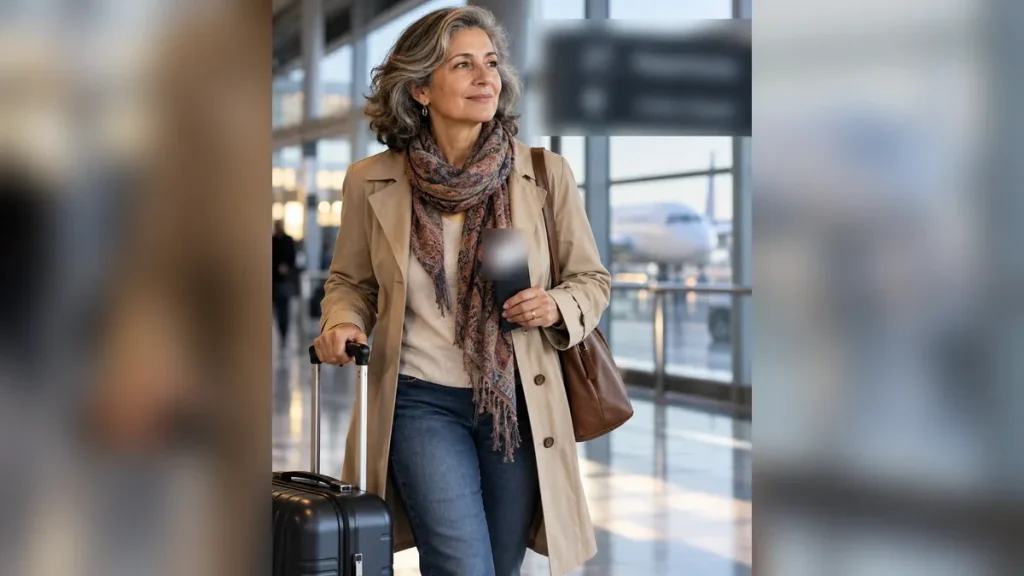
In May, I waited behind the barrier at the airport and watched travelers emerge in waves. My mother appeared pulling a small blue suitcase herself. She looked tired, irritated, and pleased.
“How was the connection?” I asked.
“Terrible.”
“Want to tell me?”
“After coffee.”
I reached for her suitcase out of habit, then stopped.
She noticed.
“You can carry it,” she said.
“Are you sure?”
“I’m asking you.”
So I took the handle.
We walked toward the exit together, me carrying the bag because she wanted help, not because I had decided in advance that she needed it.