Sunday, Nothing Special
Peter wanted the dining table gone before lunch.
“Nobody has room for it,” he said, already lifting one end.
Jonah stood in the doorway with a roll of packing tape in his hand. “It was Mom’s table.”
“It was a table Mom owned.”
“That’s the same thing to you?”
Peter let go of the table.
It was ten in the morning on their third Saturday inside the house, and they had reached the stage of grief where every object seemed to be asking them to reveal their character.
Their mother, Ruth, had died six months earlier after a short illness. Their father had been gone for nearly a decade. The house now belonged equally to the brothers, which meant every practical decision required two signatures and every emotional decision required an argument.
Peter wanted to sell before winter. He had spreadsheets for repairs, estimates from two real-estate agents, and colored stickers for KEEP, DONATE, and DISCARD.
Jonah had taken three weeks to decide what to do with a chipped blue mixing bowl.
“We can’t preserve a building by refusing to empty it,” Peter said.
“And we don’t have to erase it in a weekend.”
They compromised by leaving the table where it was and moving upstairs.
The wardrobe in their mother’s bedroom had not moved since 1987. They knew the year because Ruth had written it in pencil on the wall behind the dresser while measuring for new carpet.
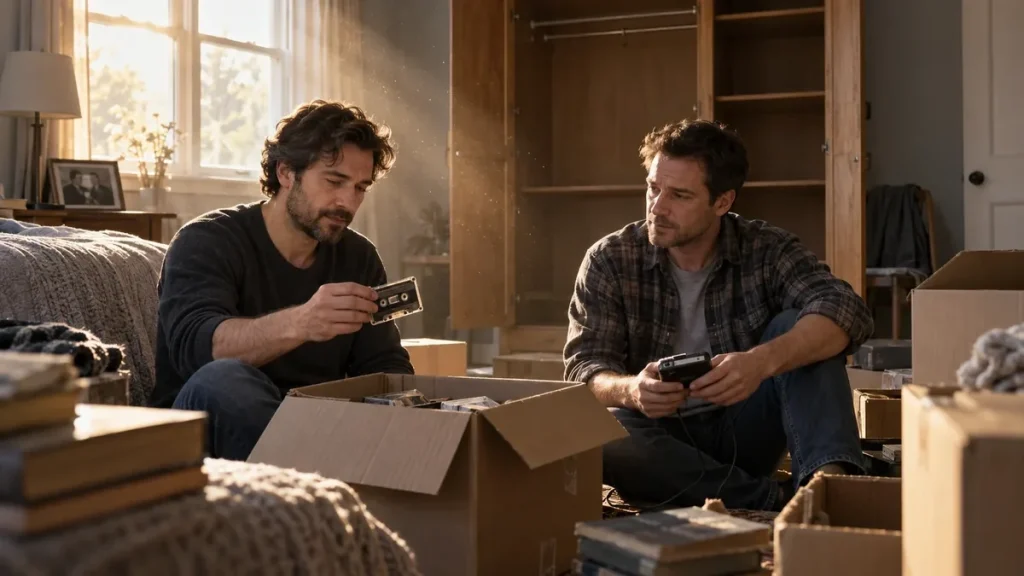
When Peter and Jonah pulled the wardrobe away from the wall, a narrow cardboard box appeared behind it, flattened with dust.
Inside were twenty-three cassette tapes.
Each had a label in Ruth’s handwriting.
RAIN DAY — APRIL 1994.
PETER’S 12TH — AFTER CAKE.
DAD FIXING SINK / BOYS ARGUING.
CHRISTMAS MORNING 1998.
Jonah sat on the floor.
“What are these?”
Peter picked up one tape and turned it over.
“Cassettes.”
“Thank you, historian.”
They found an old portable player in a hall closet, but its belt had disintegrated. The tape would not turn.
Jonah looked at the box as if Peter might attach a red DISCARD sticker to it.
“We’re keeping these.”
“Obviously.”
“You said obviously like you didn’t want to throw away her letters yesterday.”
“I said we didn’t need to keep every utility bill she had clipped to the letters.”
“You keep reducing things until they’re trash.”
Peter’s jaw tightened.
“And you keep inflating trash until it becomes sacred.”
They left separately that afternoon.
Jonah took the tapes home.
The next week he searched for a local service that could digitize them. The first shop said several tapes were too fragile. A specialist two towns away quoted an amount that made him swear at his laptop.
He called Peter reluctantly.
“I need half for the tapes.”
There was a pause.
“How much?”
Jonah told him.
“No.”
“Of course.”
“Not of course. Don’t send them there.”
“Why?”
“Because they use a high-tension transport on old shells.”
Jonah sat up.
“What?”
Peter sighed.
“Come to my house tomorrow.”
Peter lived forty minutes away in a duplex whose garage was cleaner than most kitchens. When Jonah arrived, a folding workbench had been covered with small tools, cotton swabs, replacement cassette shells, and a used professional tape deck.
On the shelf above it sat four digital audio files displayed on a laptop.
Jonah stared.
“You already did some?”
“Tried.”
“When?”
“Before we found the box.”
Peter opened a drawer and took out three tapes Jonah recognized from their mother’s desk.
“She gave me these last year. She knew the player was dying. Asked if I could transfer them.”
Jonah looked from the equipment to his brother.

“Why didn’t you tell me?”
“There wasn’t much to tell. The first deck I bought chewed a tape. So I started reading.”
On the workbench was a notebook filled with calibration notes.
Jonah almost laughed.
“You’ve become a cassette engineer.”
“Apparently.”
They spent the afternoon testing one of the newly discovered tapes. Peter opened the shell, loosened the pack carefully, cleaned the tape path, and loaded it into the deck.
At first there was only hiss.
Then their mother’s voice filled the garage.
“If you two are going to argue, at least argue near the recorder so I can use it against you later.”
Both brothers froze.
A younger Peter said, “Jonah started it.”
A child Jonah shouted from somewhere farther away, “I did not!”
Their mother laughed.
Peter reached for the stop button and missed it the first time.
Jonah looked away.
For months he had privately assigned grief roles to them. Jonah was the one who remembered. Peter was the one who managed. Jonah felt. Peter processed forms.
The labels had been wrong.
“You want to sell the house because you don’t care about this stuff,” Jonah said, then heard how childish it sounded.
Peter wiped his face with the back of his wrist.
“I want to sell the house because I can’t afford not to.”
That was the first time money had entered the argument honestly.
Peter’s business had lost a major client the previous year. He had used savings to cover payroll. His oldest daughter was starting college. The house represented equity tied up in taxes, insurance, and repairs.
“Why didn’t you say something?”
Peter gave him a tired look. “Because I didn’t want every conversation about Mom to become a fundraiser for me.”
Jonah sat on a stool beside the workbench.
“I thought you were rushing because you wanted it over.”
“I do want parts of it over.”
He pointed toward the speakers where their mother was now describing a leaking kitchen tap.
“Not her.”
The distinction changed the next month.
They still argued about the house, but the arguments became more precise. Peter admitted which repairs he could no longer comfortably carry. Jonah admitted he did not actually want the house; he wanted permission to grieve slowly.
They agreed on a sale date three months later than Peter preferred and three months earlier than Jonah wanted.
For the contents, they created a different system.
Instead of KEEP, DONATE, DISCARD, they added a fourth label: RECORD.
If an object mattered because of its story rather than its use, they photographed it or recorded themselves talking about it before letting it go. The blue mixing bowl was photographed. The dining table was sold to a young couple who arrived with a borrowed truck and promised nothing sentimental about it, which Jonah found oddly comforting.
The tapes took longer.
Some were nearly blank. Some contained radio music their mother had accidentally recorded over. One held forty minutes of rain against the kitchen windows and their father coughing in another room.
They saved all of it.
The last tape was labeled SUNDAY — NOTHING SPECIAL.
Peter transferred it after the house had sold.
They listened together in the empty dining room on the final evening before handing over the keys.
The recording contained plates, chairs, a football game in another room, and Ruth asking whether anyone wanted more potatoes.
No revelation arrived. Nobody said anything profound.
Halfway through, teenage Peter asked teenage Jonah to pass the salt.
“Get it yourself,” Jonah replied.
“You’re closer.”
“By six inches.”
Their father told them both to stop measuring.
Peter laughed in the empty room.
Jonah did too.
When the tape ended, Peter closed the laptop.
“Ready?” he asked.
Jonah looked once around the room. The table was gone. Pale rectangles marked the walls where pictures had hung. The house already looked like a place preparing to belong to someone else.
“Yeah,” he said.
They walked out together.
Peter locked the front door and handed Jonah one of the two old house keys.
“What am I supposed to do with this?”
Peter shrugged. “Keep it. Throw it away. Record a speech about it.”
Jonah slipped it into his pocket.
For once, he did not need to decide that day.