I Found a Packed Suitcase Under Mom’s Bed—And Thought She Had Planned to Leave Dad
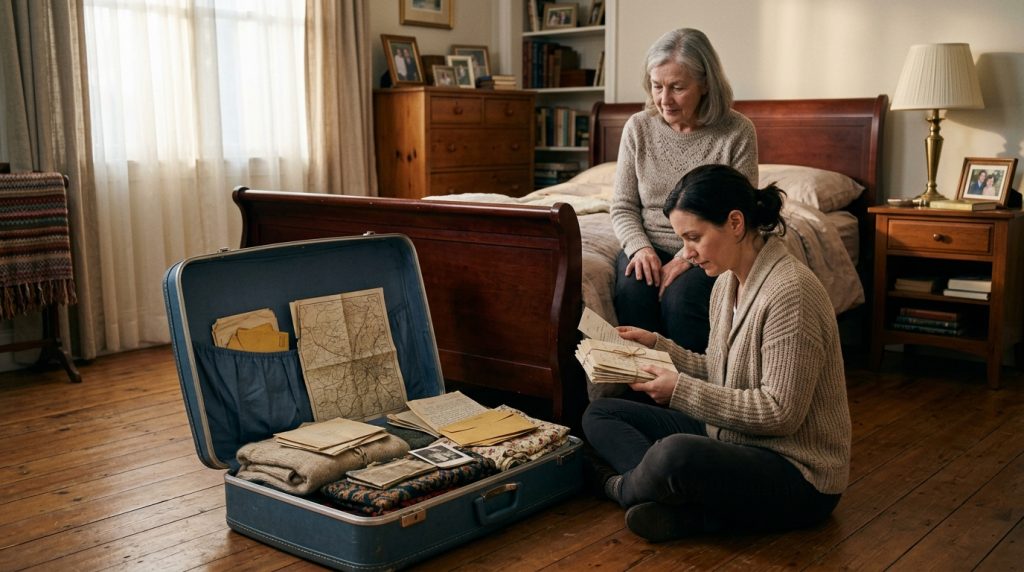
Three weeks after my father died, I found a suitcase under my mother’s bed that I had never seen before.
It was an old blue Samsonite with one broken wheel and a strip of silver tape around the handle. My mother had gone to the pharmacy, and I was changing the sheets because grief had turned her bedroom into a room she only slept in, never really entered.
I pulled the suitcase out to vacuum underneath it.
It was heavy.
I should have pushed it back.
Instead, I opened it.
Inside were two folded sweaters, three pairs of socks, a toothbrush still in its wrapper, photocopies of my mother’s passport and birth certificate, eight hundred dollars in small bills, a paper map of the state, and an envelope with my name on it.
Underneath everything was a printed train timetable.
One route had been circled in red.
I sat on the floor with the suitcase open in front of me and felt the room change.
My parents had been married for forty-one years. They argued about ordinary things—money, salt, whether the thermostat was too high—but I had never once thought my mother might have been planning to leave.
Now there was a packed bag under her bed and a route out of town.
Grief makes detectives out of people. It teaches you to treat objects like witnesses.
I picked up the envelope with my name on it.
I did not open it.
That restraint was the only thing I did right that afternoon.
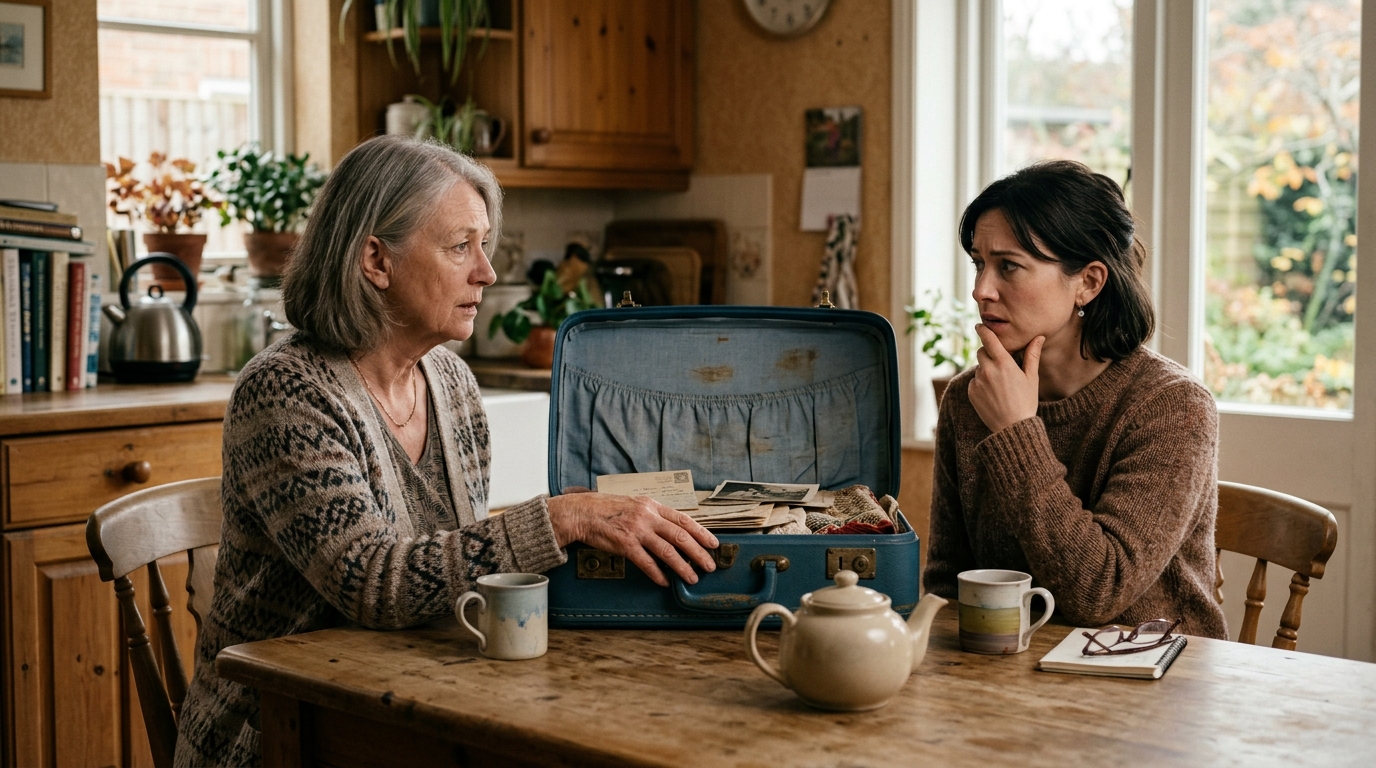
When my mother came home, she found me at the kitchen table with the suitcase beside my chair.
She stopped before setting down the pharmacy bag.
“Where did you get that?” she asked.
Not, What are you doing with that?
Not, Why were you under my bed?
Where did you get that?
As though she had lost it years ago.
“It was under your bed,” I said.
She looked tired suddenly, more tired than she had at the funeral.
“You opened it.”
“Yes.”
She sat across from me.
I waited for an explanation. When none came, anger rushed in to fill the space.
“Were you going to leave Dad?”
My mother stared at me.
Then, unexpectedly, she laughed.
It was not a happy laugh. It was the sound a person makes when reality has arrived wearing the wrong costume.
“Oh, Anna,” she said.
“Don’t ‘Anna’ me. There’s cash. Documents. A train schedule. A bag packed like you were ready to disappear.”
Her face changed when I said disappear.
She reached for the suitcase but did not close it.
“This bag is older than your marriage,” she said.
I was thirty-eight.
“What does that mean?”
She touched the silver tape on the handle.
“It means I packed the first version of it when I was seventeen.”
My mother had told me almost nothing about being seventeen.
I knew she grew up in a small industrial town two counties north. I knew her father died young. I knew she never liked canned peaches because, according to her, “Some foods belong to bad years.” That was the kind of biography she offered: fragments disguised as preferences.
She turned the suitcase toward herself.
“After my father died, my mother couldn’t keep the apartment. We moved three times in one year. Once we came home and the lock had been changed. Our things were inside and we were outside.”
I had never heard this.
“You were evicted?”
“Eventually. But before that there were warnings. Notices. People saying tomorrow, next week, end of the month. You learn something when adults keep telling you that you still have time.”
She looked at the sweaters.
“You learn not to believe them.”
The original suitcase, she explained, had belonged to her father. After the lockout, her mother made both daughters keep one bag ready. Clothes. Documents. Cash if they had any. The address of a cousin. Bus fare.
“We called them leaving bags,” she said.
“In case you got evicted again?”
“In case anything happened.”
“But you kept doing it after you married Dad?”
She nodded.
That was the part I could not understand.
My father had been steady almost to a fault. He labeled freezer containers with dates. He renewed car registration two months early. He kept receipts for appliances long after the appliances died. If safety could take human form, I would have said it looked like him in reading glasses.
“You trusted Dad,” I said.
“Completely.”
“Then why keep a bag like this?”
My mother thought for a moment.
“Because trust and fear can live in the same house.”
“Your father made me feel safe. He did not erase the girl who learned that a locked door could stop being hers overnight.”
I looked again at the train timetable.
“What about this?”
She smiled faintly.
“Your Aunt June.”
The circled station was near my aunt’s town.
“She knows?”
“She has a bag too.”
For the first time that afternoon, I felt foolish rather than betrayed.
But one question remained.
I slid the envelope across the table.
“Why is my name on this?”
My mother did not answer immediately.
Then she pushed it back toward me.
“Open it.”
Inside was a single sheet of paper in her handwriting.
The date at the top was six years earlier.
Anna, if you are reading this because something happened and I could not explain, call June first. The account information is in the green folder. Do not spend the first day making decisions. Eat something. Sleep. Then decide what actually needs doing.
The rest was practical. Insurance numbers. The name of her attorney. The location of a spare house key. Nothing dramatic.
At the bottom, she had written:
You do not have to be calm just because other people need you.
I read that sentence twice.
My father had died suddenly from a stroke. For three weeks, I had been the person who knew where the death certificates were, who called the bank, who answered relatives, who found the black shoes my mother could tolerate for the funeral.
Everyone kept telling me how strong I was.
I had started to hate the word.
“Did Dad know about the bag?” I asked.
“Of course.”
That surprised me more than anything else.
“He knew?”
“He replaced the cash every Christmas because I kept stealing twenties from it for birthday cards.”
I laughed before I meant to.
My mother laughed too.
Then she told me something I could suddenly picture perfectly.
During their first year of marriage, my father found the bag while looking for a winter blanket. He asked whether she planned to leave him. She panicked and said no. He asked why the bag was packed. She told him about the apartment, the changed lock, the nights spent on relatives’ couches.
He did not tell her the fear was irrational.
He did not unpack the bag to prove she was safe.
He bought a fireproof document pouch and put it inside.
“That was your father,” she said.
I could see him doing it. Quietly improving the emergency rather than arguing with the need for one.
For the first time since his funeral, I missed him in a way that was almost comforting.
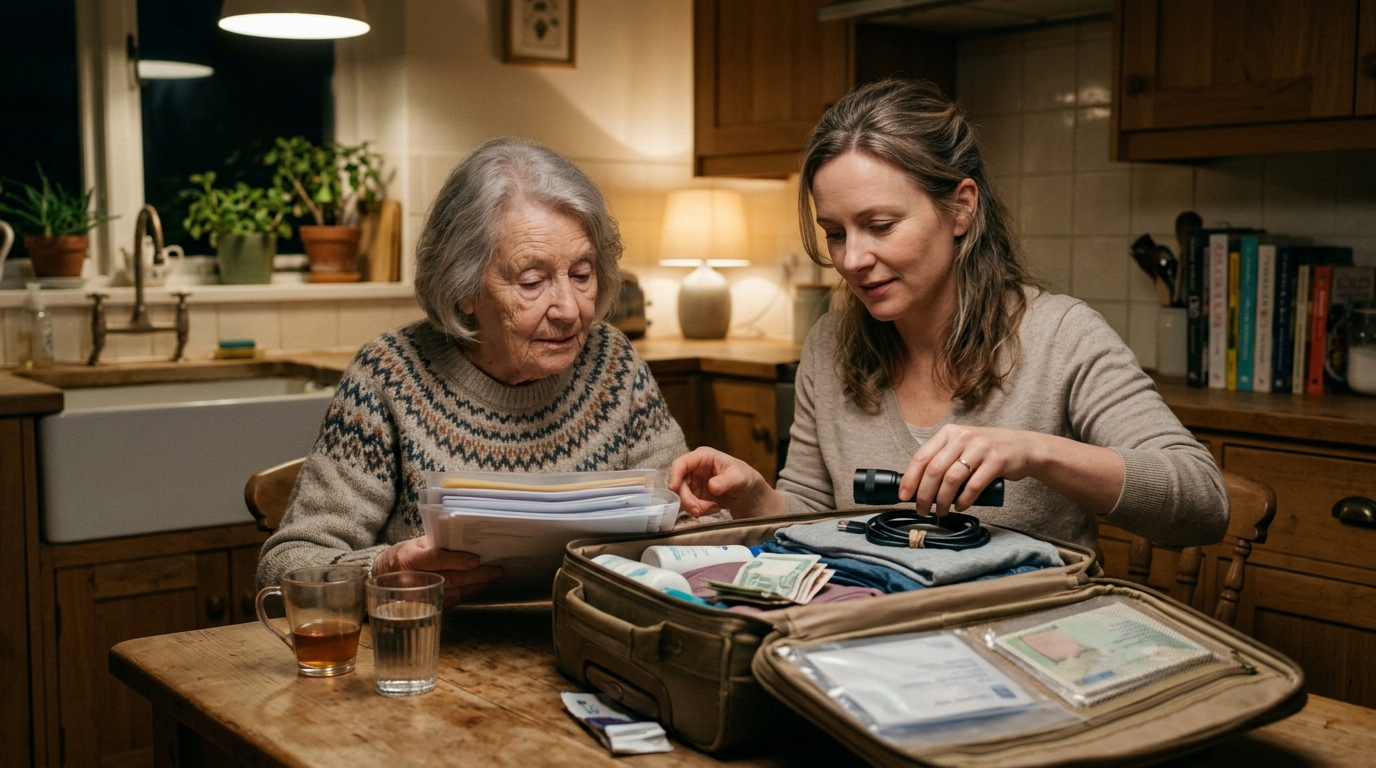
We spent the afternoon going through the suitcase.
The toothbrush had expired eight years ago. The map showed roads that had been renamed. One sweater belonged to a version of my mother who was apparently much smaller and much more optimistic about wool.
“This thing itches just looking at it,” I said.
“Your father bought that.”
“Of course he did.”
We replaced what needed replacing.
At first, the task felt strange, almost ceremonial. Then it became ordinary. New toothbrush. Fresh copies of documents. A phone charger. Medication list. A small flashlight.
I asked whether she still needed eight hundred dollars in cash.
“Probably not.”
“So we can take it out?”
She looked offended.
“Let’s not become reckless.”
I smiled.
When we finished, she zipped the suitcase and pushed it back toward the bedroom.
“Wait,” I said.
I took the envelope with my name on it and handed it back.
“Update the letter.”
“Why?”
“Because it says call Aunt June first, and she changed her number two years ago.”
My mother rolled her eyes.
“This family survives entirely because you are annoying.”
“Apparently I get that from Dad.”
She looked down at the suitcase.
“Apparently.”
A week later, I bought a small black duffel bag.
I did not tell my mother at first because I knew exactly what she would say.
I put copies of my documents inside. A charger. A sweatshirt. Some cash. A list of phone numbers I normally trusted my phone to remember for me.
Then I added a note to myself.
It did not say where to go.
It said:
Do not confuse being prepared with expecting disaster.
That was the family secret I had actually discovered.
Not that my mother had wanted to leave.
Not that my parents’ marriage had hidden some betrayal.
It was that safety is not always the absence of fear. Sometimes it is having someone who sees the fear clearly and does not shame you for carrying it.
I used to think a good family history was one with no secrets.
Now I think that is impossible.
Every family has rooms it enters slowly. Stories people tell only when the right question is finally asked. Habits that look strange until you learn what they once protected.
The important thing is what happens when the door opens.
You can accuse.
You can judge.
Or you can sit at the kitchen table, unfold the old map, and finally ask where someone learned to be afraid.