They Brought a Deed Signed by My Dead Wife
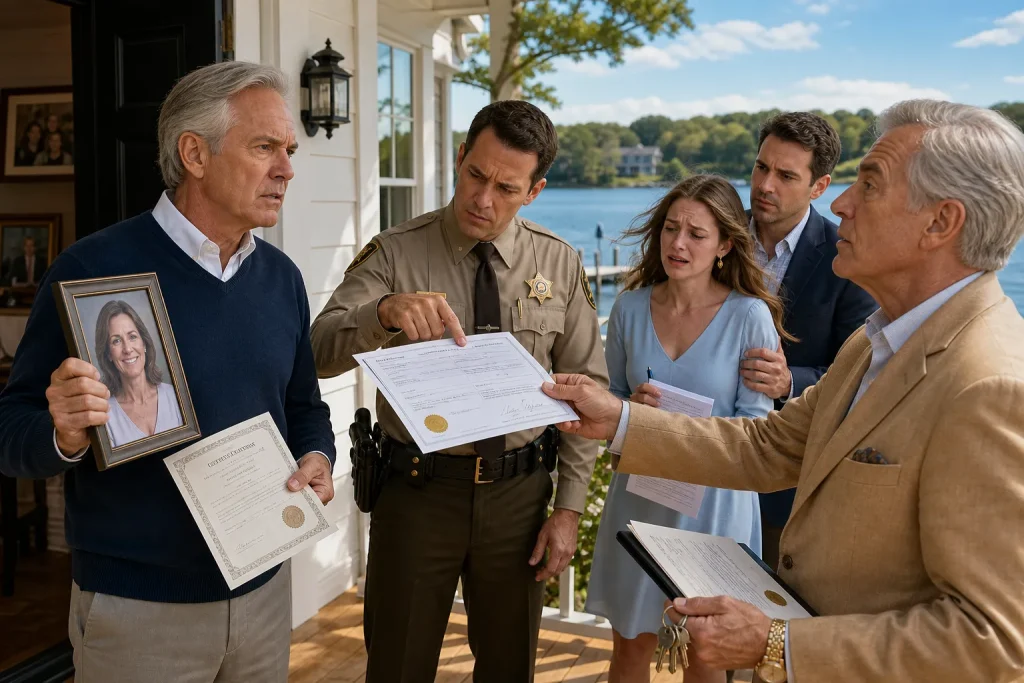
Three years after my wife died, my daughter’s in-laws arrived at our lake house with a sheriff and an eviction notice.
Ron Mercer stepped onto the porch as if he already owned it.
“Pack what you need, Tom,” he said. “Margaret transferred the property to our family.”
His wife, Linda, held up a notarized deed. Behind them, my daughter Claire stared at the ground while her husband, Derek, avoided my eyes.
Deputy Mills studied the document. “The signature appears valid.”
I looked at the familiar curve of Margaret’s name and felt the porch tilt beneath me. It resembled her handwriting perfectly.

But the date was impossible.
Margaret had supposedly signed the deed on October 14—eighteen months after I buried her.
“Dead women do not transfer houses,” I said.
Ron smiled. “Then prove she was dead when she signed it.”
My phone rang. It was my attorney, Frank Hale.
“Tom, do not leave the property,” he said. “Someone used Margaret’s death certificate yesterday to secure a two-million-dollar loan against the house.”
Deputy Mills heard every word.
He turned toward Ron. “Nobody is going anywhere.”
Ron immediately blamed Derek. Derek blamed a document service. Linda insisted Margaret had planned the transfer before her illness.
The lake house had belonged to Margaret’s family for four generations. When she became sick, she placed it inside a trust naming me as lifetime resident and Claire as beneficiary after my death. No in-law could sell, mortgage, or inherit it.
Frank arrived carrying the original trust and Margaret’s certified death record. One glance at the new deed revealed something more troubling than the date.
The witness signature belonged to Claire.
“Did you sign this?” I asked.
Tears filled her eyes. “Derek told me it was paperwork for renovating the guest cottage.”
Derek snapped that she was lying. Claire opened her phone and showed the deputy messages in which Derek instructed her to sign only the final page and promised his parents would handle everything else.
Investigators searched the county filing history. The fraudulent deed had been submitted online from Linda’s real-estate office. The notary stamp belonged to an employee who had retired two years earlier. Margaret’s signature came from a scanned anniversary card Claire had stored in a shared family drive.
The Mercers had assembled the forgery from pieces of our grief.
But why risk prison for a house they could not legally keep?
The answer was beneath the property.
Six months earlier, a development company had quietly offered Ron twelve million dollars for our shoreline. The company wanted to combine it with neighboring land and build a private resort. I had refused every offer.
Ron decided my refusal was merely an obstacle.
His plan required transferring the house, borrowing against its inflated value, and selling before the trust challenged the deed. The two-million-dollar loan would finance his failing construction company until the resort sale closed.
Claire had unknowingly provided the witness signature. Derek expected his parents to reward him with a partnership.
I looked at my daughter. She had made a terrible mistake, but shame had kept her trapped beside people who used her.
“Everyone except Claire,” I said.
Derek called her a traitor. Claire removed her wedding ring and placed it on the forged deed.
“You made me betray my father with my mother’s name,” she replied. “We are finished.”
Police arrested Ron and Linda on charges related to fraud, identity theft, and attempted mortgage theft. Derek was later charged after investigators found emails showing he knew the deed was false before Claire signed.
The loan was canceled before funds changed hands. A judge froze the resort negotiations and confirmed the trust’s ownership.
At the hearing, Ron’s attorney argued that no real harm occurred because the scheme failed.
The judge held up Margaret’s death certificate.
“The harm began when your clients treated a dead woman’s identity as office stationery.”
Claire moved into the guest cottage while beginning divorce proceedings. We attended counseling, repaired the dock together, and slowly learned to speak without defending ourselves.
One evening, she found Margaret’s old coffee tin behind a kitchen cabinet. Inside were handwritten recipes, photographs, and a note addressed to both of us.
“A house is wood and stone,” Margaret had written. “Home is the truth people protect inside it.”
The following spring, we rejected another resort offer and placed a conservation agreement on the shoreline, ensuring it could never be commercially developed.
I did not save the lake house because walls mattered more than family.
I saved it because Margaret’s final wishes mattered—and because love should never require surrendering the truth to people who call greed an inheritance.