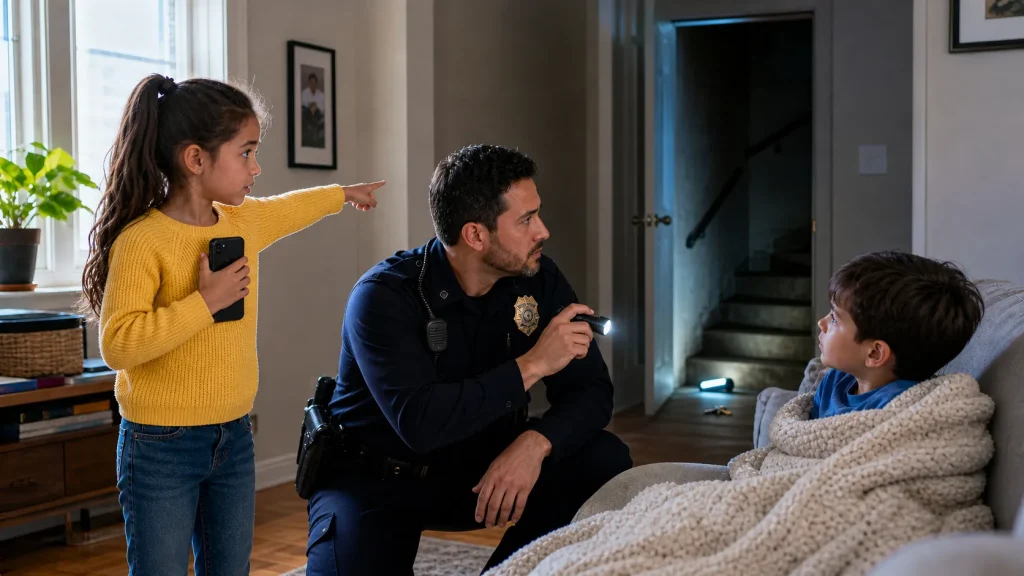
The 7-Year-Old Whispered, “Don’t Follow Mom Downstairs”
The emergency dispatcher heard a child breathing before she heard words.
“My name is Eliza,” the little girl whispered. “I’m seven. Mom went downstairs when the lights died, and she never came back.”
Behind her, a toddler cried beneath a blanket.
Dispatcher Nina Cole kept her voice calm. “Is anyone else inside?”
Eliza looked toward the apartment door. “Mom said not to follow her—even if I heard her calling.”
Police reached the building within six minutes.

Officer Daniel Reyes entered the apartment and found dinner still warm, a handbag beside the sofa, and the mother’s shoes near the basement door.
Then something struck metal beneath the floor.
Bang. Bang. Bang.
Eliza grabbed his sleeve. “That’s Mom. Three knocks means she’s alive.”
Before Daniel could open the basement door, the building manager, Mr. Vale, rushed upstairs holding a ring of keys.
“Maya left hours ago,” he insisted. “The child has nightmares.”
The dispatcher was still listening through Eliza’s phone. Suddenly Nina heard a faint woman’s voice beneath the static:
“Do not let Vale take them downstairs.”
Daniel looked at the manager’s shoes. Fresh gray cement covered both soles.
Daniel moved Eliza and her brother behind his partner, Officer Bennett.
“Put the keys on the floor,” he told Vale.
Vale laughed nervously. “This is ridiculous. The basement is flooded and unsafe.”
The officers unlocked the door. A narrow staircase descended into darkness. Halfway down, Daniel’s carbon-monoxide detector began screaming.
Firefighters evacuated the building while a rescue team entered with breathing equipment. Vale attempted to slip through the crowd, but Bennett stopped him at the front entrance.
The basement appeared ordinary: pipes, storage cages, and an old laundry room. Yet Maya’s phone continued ringing somewhere behind a freshly painted wall.
Eliza remembered something her mother had said that afternoon.
“She found a door where no door should be.”
Firefighters removed a thin panel concealed behind shelving. Beyond it was a sealed utility corridor leading to a forgotten storm shelter beneath the neighboring building.
Maya lay inside, conscious but weak, using a wrench to strike a heating pipe. A fallen metal cabinet blocked the door from her side, while a new padlock had been fitted outside.
Paramedics carried her into the daylight. Eliza ran forward, but stopped when Maya lifted one finger—their signal to wait until the oxygen mask was removed.
Then mother and daughter held each other without speaking.
For months, tenants had received impossible utility bills. Maya, an electrician, discovered that someone had rerouted power from twelve apartments into a hidden server room. Vale was using residents’ electricity to operate illegal cryptocurrency machines.
That evening, Maya photographed the wiring. Vale surprised her in the corridor. During their argument, an overloaded cable sparked, cutting power throughout the building. Maya ran into the shelter to reach the emergency breaker.
Vale locked the outer panel, expecting fumes from a damaged boiler to make her lose consciousness before anyone found her.
He then returned upstairs and told neighbors she had abandoned her children.
But Maya had taught Eliza three emergency rules: call for help, protect her brother, and listen for three knocks through the heating pipe.
The strange warning not to follow her had protected both children from the carbon monoxide below.
Police found Maya’s photographs automatically backed up to cloud storage. They showed the stolen wiring, mining equipment, and Vale carrying tools into the hidden corridor. His cement-covered shoes matched dust around the newly installed padlock.
Vale was charged with unlawful confinement, reckless endangerment, utility theft, and fraud. Inspectors condemned the basement until the wiring and boiler could be repaired.
The neighbors who had accused Maya of leaving were suddenly eager to apologize. She accepted their concern but not their judgment.
“A frightened child needed help,” she said. “Not gossip.”
Weeks later, the fire department invited Eliza to visit the station. Nina, the dispatcher, attended too. It was the first time Eliza saw the woman whose voice had stayed with her through the darkness.
Nina knelt and handed her a small certificate for bravery.
Eliza shook her head. “Mom was brave. I only remembered what she taught me.”
“That is what bravery is,” Nina replied. “Remembering what matters while you are afraid.”
When the family returned home, new lights illuminated every basement stair. The hidden wall was gone, and the storm shelter had become a legal emergency room with alarms and ventilation.
Eliza still disliked blackouts. Whenever thunder shook the windows, Maya tapped three times on the table.
Eliza always tapped back.
Not because danger remained beneath them—but because three knocks now meant something stronger than fear:
We are here. We hear you. You are not alone.