The Bus Driver’s Sunday Route
Every Sunday, the same six passengers boarded Daniel Reed’s bus and traveled nowhere.
They entered at different stops, paid the fare, and remained aboard for the entire seventy-minute loop. When the bus returned to their neighborhoods, they stepped off within a few streets of where they had begun.
Daniel noticed because Sunday Route 18 was rarely busy.
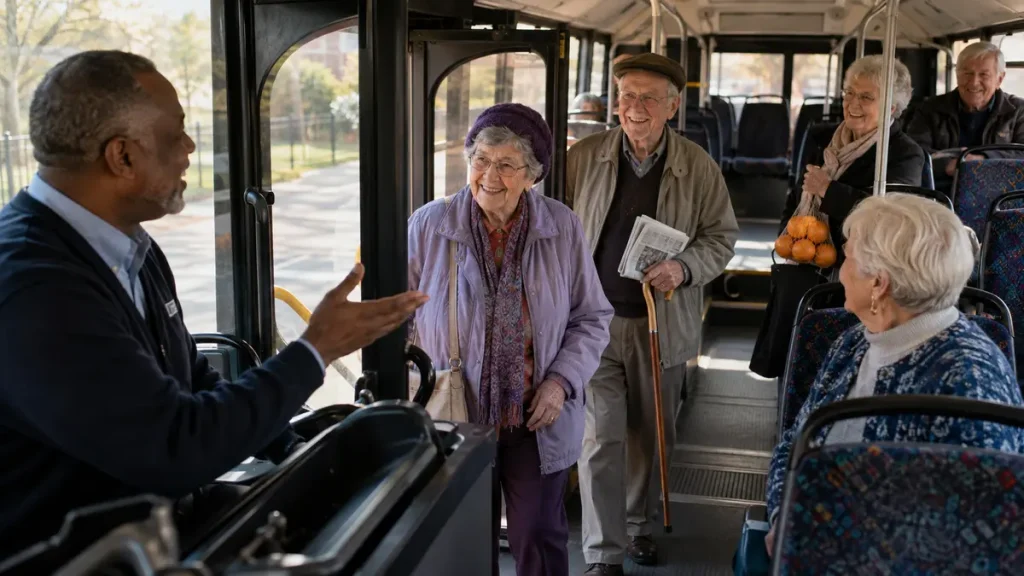
Mrs. Chen boarded first with a canvas shopping bag that was always empty. Mr. Alvarez carried a folded newspaper but never opened it. Ruth wore a purple hat in every season. The other three sat separately and stared through the windows.
At first, Daniel assumed they were going to church, the market, or the park.
But they never left the bus long enough to reach any destination.
One Sunday in February, freezing rain delayed traffic. The route took two hours. Daniel expected complaints.
Instead, the six passengers appeared almost pleased.
At the final stop, Mrs. Chen approached the driver’s seat.
“Same time next week?” she asked.
“The timetable is the same.”
“Good.”
Daniel began listening.
Mrs. Chen greeted the bakery owner through the window. Mr. Alvarez counted dogs in the park. Ruth hummed whenever the bus crossed the river. Nobody used a phone. Nobody seemed impatient to arrive.
Then one Sunday, Mr. Alvarez did not board.
At his usual stop, Ruth stood and looked down the street.
“Wait one minute,” she called.
Daniel was not allowed to wait without reason. He waited anyway.
Mr. Alvarez appeared, walking slowly with a cane. When he climbed aboard, the other passengers applauded. He explained that he had fallen in his kitchen two days earlier.
“Who helped you?” Daniel asked.
“Eventually, the neighbor heard me.”
After the route, Daniel checked the passenger assistance notes available to drivers. All six Sunday regulars were over seventy. All six lived alone.
👇
The following week, Daniel placed a box of tea bags near the front and brought a thermos of hot water. Officially, drinks were prohibited. Unofficially, Route 18 became warmer.
Mrs. Chen filled her empty shopping bag with oranges and distributed them. Ruth brought biscuits. Mr. Alvarez finally opened his newspaper and read the strangest headlines aloud.
The passengers began sitting closer together.
Daniel learned that the ride was the only weekly outing for three of them. Mrs. Chen’s daughter called every evening from another country, but the apartment remained silent all day. Ruth had stopped attending church after her hearing declined. Mr. Alvarez once walked everywhere but now feared falling outdoors.
They were not using the bus to reach a place.
They were using it to be among people without having to explain that they were lonely.
Daniel asked his supervisor whether Sunday Route 18 could include a fifteen-minute rest at Riverside Park. The request was denied. Timetables were fixed, and buses were transportation, not social clubs.
So Daniel followed the timetable exactly.
He also began driving more gently, announcing landmarks like a tour guide, and greeting every passenger by name. At Riverside Park, traffic mysteriously required him to stop near the public garden for several minutes.
Word spread.
The six became ten, then fourteen. A retired teacher brought trivia cards. A widower named Colin carried a portable chessboard. Two teenagers began riding to practice conversational English with Mrs. Chen, who corrected them sternly and fed them oranges.
Not everyone was elderly or alone. A nurse rode after a night shift because the familiar voices helped her unwind. A father brought his young son, who loved buses and knew every stop. A woman recovering from surgery used the loop to rebuild confidence before traveling farther.
The transit authority noticed the unusual Sunday ridership.
An inspector boarded without warning.
Daniel removed the tea box before she reached the front, but he could not hide fourteen passengers singing to Ruth on her birthday.
After the route, the inspector asked why nobody had traveled more than five miles from home.
Daniel told her the truth.
Two weeks later, he received an official warning for unauthorized delays and beverages. He also received an invitation to a planning meeting.
The authority was testing a Sunday Community Loop with scheduled rest stops at the park, library, market, and health center. Volunteer hosts would ride alongside the driver. The fare would remain standard so nobody had to register for a “loneliness program.”
Daniel insisted on one condition: passengers could ride simply because they liked the view.
The pilot began in May.
Mr. Alvarez became the unofficial dog counter. Mrs. Chen managed snacks despite repeated reminders that she was not in charge. Ruth chose songs for the river crossing.
On the first anniversary of the route, Daniel’s supervisor joined them. At Riverside Park, passengers left the bus for a picnic. For once, nobody worried about missing the next departure.
Mr. Alvarez sat beside Daniel beneath a tree.
“You know,” he said, “we did have destinations.”
“You rode in circles.”
“So does the earth. It still gets somewhere.”
The Community Loop later expanded to three districts. Reports measured ridership, medical access, and connections to public services. They did not measure the number of birthdays celebrated, oranges shared, or people who began leaving home again.
Daniel measured those himself.
Years later, when he retired, the passengers presented him with the old Route 18 sign. Beneath the number, they had written:
THE LONG WAY HOME.
Daniel hung it above his kitchen table.
Every Sunday after that, someone from the route arrived at ten with tea, newspapers, biscuits, or nowhere else they particularly needed to be.