He Buried Grandma’s Fortune
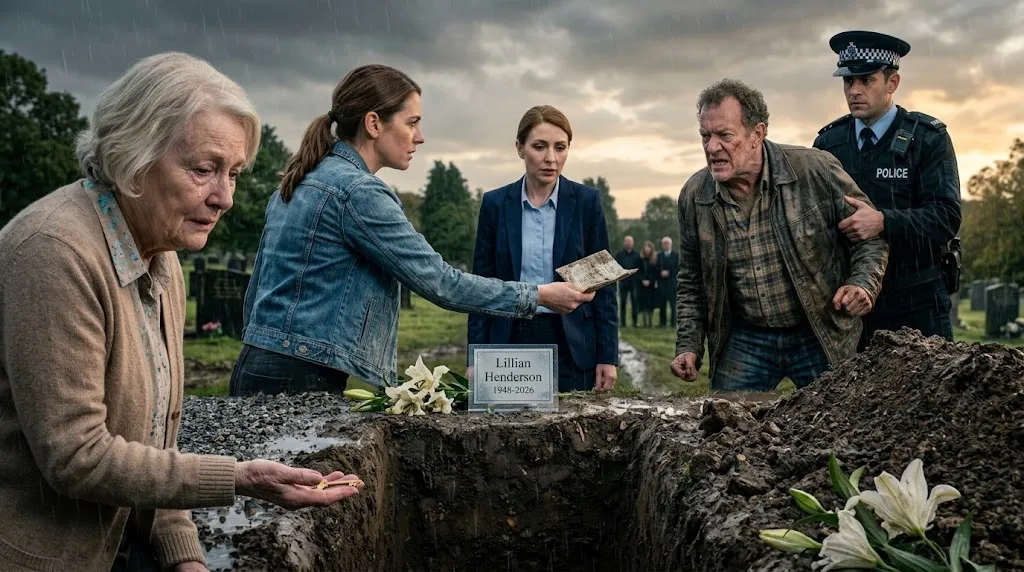
At my grandmother’s funeral, I watched my father throw her savings book into the open grave.
“Worthless paper,” Richard said, brushing soil from his coat. “Your grandmother died with nothing.”
I almost believed him. Grandma Margaret had lived modestly, reused tea bags, and counted every coin before buying groceries. But as the mourners walked away, Aunt Maggie slipped a brass key into my hand.
“Your grandmother knew Richard would lie,” she whispered. “Go to First County Bank. Ask for box 317—and do not tell your father.”
The next morning, I sat across from the bank manager while rain hammered the windows. He examined the muddy savings book I had secretly retrieved from the grave, then looked at me as if I had carried in something dangerous.
“Miss Henderson,” he said, locking his office door, “this book is not worthless. It is connected to an account containing $840,000.”
My breath disappeared.
“Then why did my father destroy it?”
The manager turned his computer screen toward me. A withdrawal request for the balance had been submitted three days before Grandma died.
The signature looked like hers—but Grandma’s right hand had been paralyzed for six months.

Before I could speak, someone tried the locked door.
The manager went pale. “Your father is here.”
Then Richard called through the glass: “Chloe, give them the key. You have no idea what your grandmother really did.”
The manager pressed an alarm beneath his desk. Richard smiled through the glass, but his eyes remained fixed on my closed fist.
“What is inside box 317?” I asked.
“Proof,” he replied. “And a confession.”
Two security guards arrived and escorted Richard to the lobby. He did not resist. He simply called me ungrateful and promised that opening the box would destroy our family.
It already had.
Inside the vault, the brass key opened a narrow metal drawer. There was no jewelry. Instead, I found a red ledger, a flash drive, and a sealed letter bearing my name.
My dearest Chloe,
If you are reading this, your father tried to take what was never his.
Grandma’s letter explained everything. Twenty years earlier, she had sold land inherited from her parents. Richard convinced the family she lost the money in a failed investment, but she had quietly placed it in trust for her grandchildren. She feared Richard’s gambling debts and refused to let him control it.
The ledger recorded every loan she had given him—more than $300,000 over twelve years. The flash drive contained security footage from her kitchen. In the final recording, Richard placed papers before her and guided a pen into her unresponsive hand.
“Sign it,” he demanded. “You owe me.”
Grandma stared directly at the hidden camera.
“I owe you the truth,” she said.
The forged withdrawal had been delayed because Grandma instructed the bank to require both the savings book and the brass key. Richard buried the book to convince everyone the account was empty, but he never found the key.
Police arrested him before noon. He insisted Grandma had promised him the money, yet the recordings, medical records, and forged signature told another story.
During the investigation, I discovered something even more painful. Richard had not visited Grandma during her final weeks to care for her. He had searched her house each night, opening drawers while she slept and questioning nurses about missing documents.
The court canceled the withdrawal and preserved the trust. I did not spend my share on luxury. I restored Grandma’s cottage and turned it into a temporary home for older women recovering from financial abuse. Aunt Maggie became its first volunteer.
Months later, I returned to the cemetery with a new copy of the savings book. I placed it beside Grandma’s roses, not in the soil.
“You were never poor,” I whispered. “You were protecting us.”
Wind moved through the trees, lifting one corner of the cover. Inside, I had written the sentence Richard tried to bury with her: