The Restaurant That Served the Wrong Dinner
The restaurant served the wrong dinner to every table before Rosa Bellini understood that her nephew’s handwriting was the least of her problems.
It was the tenth anniversary of The Little Fig, the fourteen-table restaurant Rosa had built in a former stationery shop. Every reservation had been confirmed twice. The candles were new, the linen was pressed, and a food columnist from the city paper sat by the window with a notebook beside his water glass.
Rosa had planned the evening down to the minute.
At six forty, her head waiter called from an urgent-care clinic. At six fifty, the dishwasher resigned by text. At seven, Rosa’s mother, Teresa, arrived without warning and ran one finger along a shelf as if preparing evidence for a trial.
“You missed a spot,” Teresa said.
“Happy anniversary to me.”
Rosa’s sixteen-year-old nephew, Nico, offered to manage the dining room. He had never waited a table, but he wore a clean shirt and possessed the confidence of someone who had not yet discovered the problem.
“I use an app for school projects,” he said. “This is the same thing, except people eat.”
Rosa gave him a paper order pad because the restaurant’s tablet system had frozen during an update.
His handwriting resembled insects escaping a flood.
At seven thirty, Nico leaned into the kitchen. “Table four wants sea bass.”
“Table four ordered mushroom pasta,” Rosa said.
He turned his pad sideways. “Then table seven wants sea bass.”
“Table seven listed a fish allergy on the reservation.”
Nico looked at the dining room, then at his notes. “Could the tables have moved?”
“The tables are furniture.”
By eight fifteen, every order was in the wrong place.
The couple celebrating their fortieth anniversary received a child’s cheese pizza. An eight-year-old waiting for plain noodles received grilled octopus. A family of six received two tiny tasting menus, while two women on a visibly awkward first date were given a platter built to feed a reunion.
Teresa received a bowl of white bean soup that Rosa had removed from the menu three years earlier.
The columnist received nothing.
Rosa considered pulling the fire alarm. Instead, she moved from table to table with a strained smile and a stack of apology cards.
At the anniversary table, she reached for the pizza.
“Please let me replace that.”
The husband covered the plate with both hands. “Absolutely not.”
His wife was already laughing. “We ate this on our first date. He dropped half of his slice on my shoe.”
“You told me it was charming.”
“I had known you for twenty minutes.”
They asked Rosa for two paper crowns from the children’s menu and ate the pizza with a bottle of Barolo that cost more than the meal.
Across the room, the eight-year-old studied a tentacle with grave concentration. His father requested an immediate exchange. The boy refused.
“It has little buttons,” he said.
“Those are suction cups.”
“Can I taste a button?”
He ate one piece, then another. His father looked personally betrayed; he had spent eight years cooking plain noodles.
The family of six divided each tasting-menu portion into six microscopic bites. Their youngest child filled up on bread and announced that fancy food was “mostly empty plate.”
At Table Eleven, the two women stared at their enormous platter of roasted vegetables, dumplings, grilled chicken, and three sauces.
They had exhausted safe topics and were approaching silence.
“We could send it back,” one said.
“Or determine whether the green sauce is dangerous,” said the other.
They began negotiating portions. Within five minutes they were arguing cheerfully over the last dumpling and inventing the family who ought to have received the feast.
“Three children,” the first woman decided.
“Four. The youngest only eats bread.”
At the center table, a serious-looking man dining alone received a chocolate cake with two candles.
He raised one hand.
Rosa hurried over. “I know. You didn’t order this.”
“No.”
“It belongs to twins at Table Eight. I’m sorry.”
The man looked at the candles. “It is my birthday.”
Rosa assumed he was making a joke until he showed her his driver’s license. Harold Levin, sixty-two that day.
“Why didn’t you tell us?” she asked.
“I didn’t tell anyone.”
His daughter was teaching abroad. His closest friend had moved to another state. Harold had chosen The Little Fig because a busy room felt less lonely than his apartment, but he had planned to leave before dessert.
The twins heard him. They carried their chairs to his table and reclaimed only one condition.
“You may borrow our cake,” one said.
“But we keep the birthday song,” said the other.
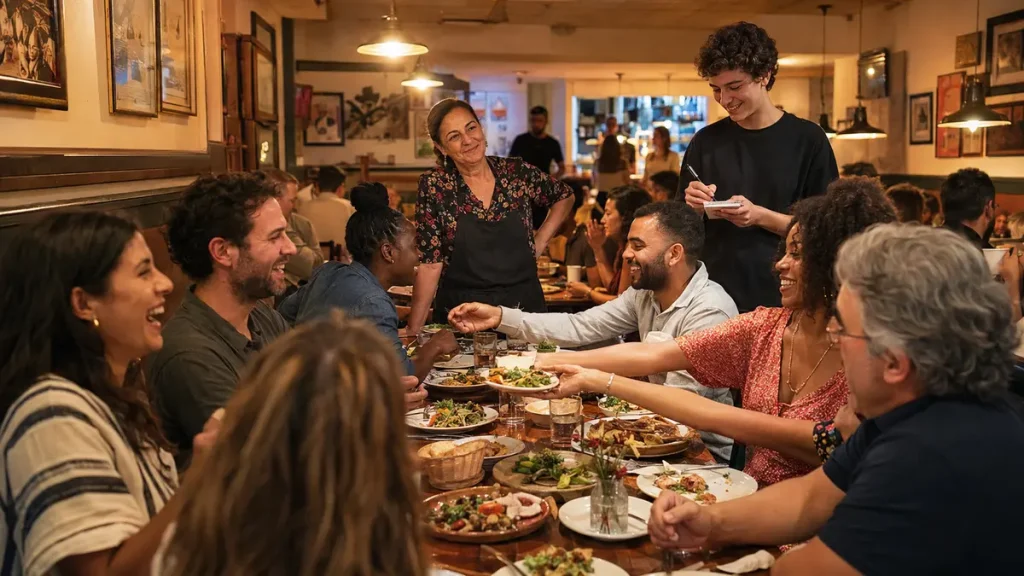
They sang loudly and without agreement on the key. The anniversary couple joined in. Then the family of six. Even the columnist put down his notebook.
Harold closed his eyes before blowing out the candles.
Rosa stopped apologizing long enough to look around.
Guests were speaking across tables. The father of the adventurous eight-year-old offered plain noodles to the youngest child from the family of six. The two women with the platter sent roasted vegetables to the anniversary couple and received pizza in return.
The room had become untidy, noisy, and impossible to manage.
It was also happier than it had been an hour earlier.
Only the columnist remained without food.
Rosa carried him the fastest dish available: Teresa’s white bean soup, which had landed back in the kitchen untouched.
“This is not what I ordered,” he said.
“Tonight that statement applies to everyone.”
He tasted the soup. Then he tasted it again.
“Who made this?”
Teresa raised one hand from her table.
The soup was her mother’s recipe—white beans simmered with lemon peel, rosemary, and the end of a Parmesan rind. It had sustained Rosa through childhood winters and the first lean months of the restaurant.
Rosa had removed it because a consultant called it rustic and suggested dishes that photographed better.
“This is the best thing I’ve eaten tonight,” the columnist said.
Teresa looked at Rosa with unbearable satisfaction.
“Do not enjoy this,” Rosa warned.
“I have waited three years,” Teresa replied. “Allow me a minute.”
The kitchen tried to rebuild the original orders, but the dining room developed its own system. Guests passed plates, traded dishes, and warned one another about allergies. Nico stopped pretending he understood the seating chart and began carrying bread wherever he heard laughter.
Then Rosa discovered a real problem.
The family platter contained chicken, and one of the women at Table Eleven had ordered vegetarian food. She had not eaten it, but Rosa’s relief quickly became anger.
“This could have been serious,” she told Nico beside the pantry.
His confidence vanished. “I checked the allergy notes.”
“You checked the wrong tables.”
“I was trying to help.”
“Helping requires admitting when you’re lost.”
Nico stared at the floor. Rosa recognized the expression because she had worn it through her first year as a restaurant owner.
She took a breath and gave him a clean sheet of paper.
“Write allergies only. Print clearly. Take it to every table and ask again.”
He looked up. “I’m not fired?”
“You were never hired.”
“That sounds worse.”
“Go.”
Nico visited every table, apologized without jokes, and confirmed each restriction. The guests responded more kindly to his honesty than they had to his earlier confidence.
By nine thirty, four small tables had been pushed into one long row. Harold learned that one of the twins worked near his apartment. The anniversary couple debated marriage with the two women from Table Eleven, who had relaxed enough to admit it was their first date.
The columnist watched Rosa move through the room.
“Did you arrange this?” he asked.
“If I had arranged it, the napkins would still be folded.”
“Then why haven’t you corrected it?”
Rosa considered the question.
“Because everyone is fed, every allergy is now accounted for, and correcting it would mean separating people who chose to sit together.”
At closing time, guests lingered as if leaving would break something.
The anniversary couple reserved the same table for the following year and requested the cheese pizza. Harold left with the twins’ phone numbers and an invitation to their weekend walking group. The family of six packed the remaining platter for home.
The two women from Table Eleven stayed until Rosa began stacking chairs.
“We’d like to reserve next Friday,” one said.
“Which table?” Rosa asked.
They glanced at the long row everyone had created.
“Does it matter?”
After the doors closed, Nico sat on an overturned crate in the kitchen.
“I ruined the anniversary.”
Rosa handed him a bowl of his grandmother’s soup.
“You made dangerous mistakes. Don’t confuse a lucky outcome with good work.”
He nodded.
“But you also stayed, apologized, and fixed what you could. That part matters.”
Teresa, washing glasses because the dishwasher had quit, pretended not to listen.
The next morning, Rosa expected hostile reviews. Instead, photographs appeared online of strangers passing plates beneath captions such as THE DINNER WE DIDN’T ORDER and BEST MISTAKE OF THE YEAR.
The columnist’s review praised the cooking but did not romanticize the confusion. He noted the allergy risk, the understaffing, and Rosa’s decision to stop hiding the failure.
His final paragraph focused on the soup.
He described it as a dish with no ambition beyond warming the person in front of it.
Rosa returned the white bean soup to the menu under its original name: Teresa’s Tuesday Soup.
“My full name should be included,” Teresa said.
“Do not push your luck.”
A month later, Rosa introduced a carefully designed communal supper. Guests listed dietary needs in advance but did not choose their dishes. The tables were joined, serving plates were shared, and Nico built a digital system that displayed every allergy in red before an order could be sent.
He worked only weekends and was required to read every table number aloud.
Harold attended the first supper with the twins. The anniversary couple came for pizza. The women from Table Eleven arrived together and left holding hands.
Customers sometimes asked whether the original disaster had been a clever anniversary promotion.
Rosa never improved the story.
“No,” she said. “It was terrible service.”
Then she would place a bowl of her mother’s soup between people who had not met and let them decide who received the first spoonful.