The Boy Who Repaired Broken Radios
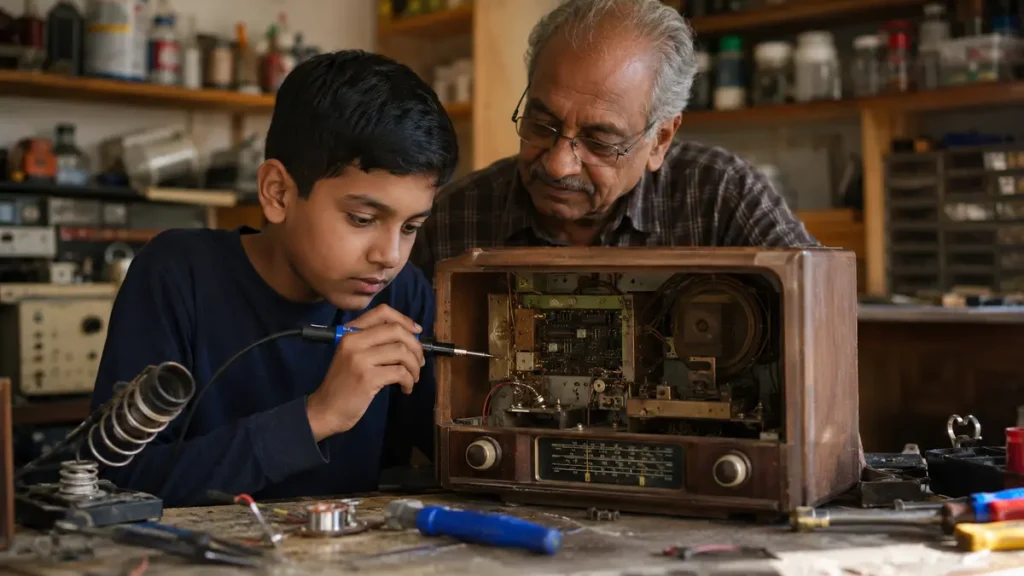
The boy repaired broken radios because he disliked the idea that a voice could disappear over one loose wire. Every afternoon, after school, Arun Mehta sat at the scarred counter of his grandfather’s shop and opened plastic cases that smelled of dust, warm metal, and old kitchens. He knew which screws would strip, which springs would leap, and which owners would wait outside pretending not to worry.
Mehta Radio & Clock stood between a bakery and a tailor on Station Road. Its blue sign had faded almost white, but the bell above the door still gave a bright, confident ring. People brought Arun pocket sets from cricket seasons, kitchen radios stained with turmeric, and heavy wooden receivers that had once announced births, elections, and monsoon warnings.
His grandfather Dev inspected every repair before returning it. He never praised with more than a nod. Still, Arun collected those nods carefully. They meant the solder held, the dial moved cleanly, and a neighbor would carry a familiar voice home.
Only one radio in the shop was forbidden. It sat on the highest shelf beneath a square of muslin: walnut cabinet, brass dial, cloth speaker grille the color of tea. Arun had never heard it play. Whenever he asked, Dev said, “That one is not a customer’s.”
On the first Monday of June, Mrs. Fernandes arrived with a green portable set clutched against her chest. The weather office had warned that the river might rise before nightfall, and her apartment building’s emergency messages came through the community station. Her radio hissed but caught no words.
Arun replaced a cracked wire, cleaned the contacts, and turned the dial. A weather bulletin emerged through the static: heavy rain by evening, possible power cuts, residents near the old bridge advised to prepare. Mrs. Fernandes exhaled as if the little box had returned more than sound.
“Your grandmother used to read those warnings,” she told Arun.
Dev, who had been sorting batteries, dropped one. It rolled beneath the counter. “Long ago,” he said, without looking up.
Arun had known that his grandmother Leela sang beautifully and died when he was six. He did not know she had worked at the station. On the walk home, he asked his father, who paused too long before saying Leela had hosted a weekly program called Songs from Home. Listeners sent letters, recipes, dedications, and news from relatives working far away.
“Why has no one told me?” Arun asked.
“Because your grandfather does not visit rooms after he has locked them,” his father said.
By five o’clock, rain hammered the metal awning. Power failed along half of Station Road. Mobile service weakened, then vanished. Neighbors crowded into the shop because Dev kept a battery receiver for emergencies. The community station announced that water had covered the road near the school and asked residents to stay indoors.
Then the shop’s emergency radio coughed twice and died.
Dev opened it, tested the battery pack, and frowned. A corroded terminal had snapped; the replacement piece was at a supplier across the flooded market. Around them, people began arguing about whether the old bridge was open. Mrs. Fernandes needed to know if her sister’s building had been evacuated. The baker’s son was stranded at football practice.
Arun looked toward the muslin-covered radio. Its cabinet was large enough to hold a stronger receiver, and Dev kept a box of matching valves below the clock bench. “We can repair that one,” he said.
“No.”
“We need the station.”
“There are other ways.”
Arun pointed to the dark phones in everyone’s hands. “Show me one.”
Dev’s face tightened. For several seconds, only the rain spoke. Then he took the walnut radio down himself and set it on the bench. His hands, usually exact, trembled as he removed the back.
Inside, the radio was surprisingly clean. A paper label on the chassis carried Leela’s handwriting: HOME SET—DO NOT THROW AWAY. Arun tested the valves and found one burned out. The tuning cord had also slipped from its wheel. Both faults were ordinary. The silence was not.
“You could have fixed this years ago,” Arun said.
Dev stared at the dark glass valve. “Yes.”
His grandfather rested both palms on the bench. He said that on Leela’s final night at the station, she had recorded a program for the next week because she was going into hospital. She never returned home. The station broadcast the recording after her funeral, and this radio had been playing in the shop. When the program ended, another announcer spoke. Dev pulled the plug before the new voice finished the first sentence.
“I left it broken,” Dev said, “because if I heard the station continue, then the world had continued without her. I was not ready for that. After a while, I was ashamed that I was still not ready.”
No one in the shop moved. Arun understood why his father had called grief a locked room. But outside, the river was rising in a world that had continued anyway. He placed a fresh valve beside the chassis and waited.
Dev picked it up. “Show me the tuning cord.”
They worked side by side while candles flickered on the counter. Arun looped the cord around the dial wheel; Dev held the spring steady. They cleaned the contacts, checked the transformer, and connected a battery inverter. When Arun turned the brass knob, the speaker released a low hum, then a wash of static.
He moved the dial slowly. A film song flashed past. A preacher’s voice dissolved. Finally the community announcer came through, faint but understandable: the old bridge was closed; the school children were safe in the municipal hall; residents of Mrs. Fernandes’s block should move to the second floor but did not need evacuation.
Relief traveled through the shop in small sounds—chairs scraping, breath leaving lungs, someone laughing once. The baker wrote the instructions on paper and ran them door to door beneath a sheet of plastic. Mrs. Fernandes squeezed Arun’s shoulder before calling to her sister from the upstairs landline.
After the bulletin, a woman from the station said they would fill the next hour with recordings from the town archive while the storm disrupted the regular schedule. The first archive tape crackled. A younger Leela Mehta introduced Songs from Home.
Dev reached for the switch.
Arun did not stop him. He only said, “We can turn it off. But we can also listen for one minute.”
Dev’s fingers stayed on the knob. Leela read a dedication from a railway porter to his wife, then laughed when the requested song began at the wrong speed. Her laugh was smaller than Arun remembered and more alive than any photograph. Dev lowered himself into the chair behind the counter.
One minute became ten. People listened without making a ceremony of it. During the last song, Dev told Arun that Leela had chosen the walnut cabinet because it made every voice sound as if it belonged in the room. He admitted he had kept the station’s archive letter unopened in the cash drawer for eleven years.
The storm passed after midnight. The next morning, Dev opened the letter. The station had preserved forty-three of Leela’s programs and offered the family copies. By afternoon, Arun and Dev were sitting in the archive office, choosing which reels to digitize first.
Arun did not turn the shop into a memorial. He thought Leela would have disliked that. Instead, he placed the walnut radio on a lower shelf with a small card: WORKING—ASK BEFORE SWITCHING ON. On Saturdays he invited children from the neighborhood to bring broken sets and learn how to open them without fear.
Dev taught the first class how to test a fuse. Arun taught the second how to follow a signal through a circuit. At the end of each lesson, they played one of Leela’s programs, never more than a few minutes unless Dev requested another.
Months later, the community station asked Arun to host a short segment about repairing household electronics. He refused twice, then agreed on the condition that Dev sit in the studio. When the red light came on, Arun saw his grandfather through the glass, wearing headphones and holding Leela’s old script.
Arun leaned toward the microphone. He had spent years rescuing other people’s voices from loose wires and tired batteries. Now he understood that some silences were not mechanical, and they could not be forced open. They had to be approached carefully, with patience, tools, and someone willing to stay in the room.
“Good evening,” he began. “This is Mehta Radio & Clock. Let’s see what we can bring back.”


Pingback: The Last Garden on Platform Nine | Inspiring Story