The Last Garden on Platform Nine
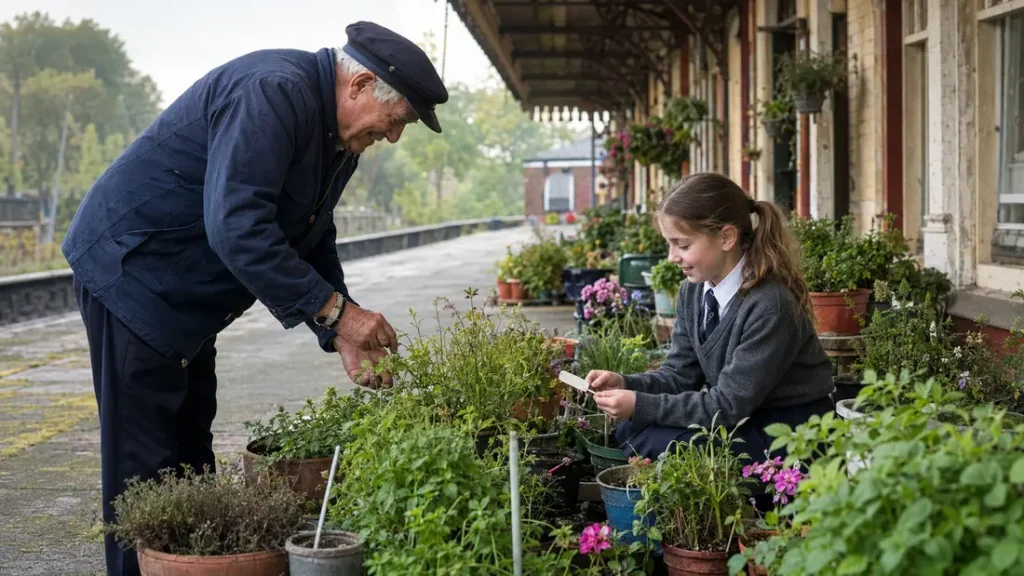
The last garden on Platform Nine began with six clay pots, a rusted watering can, and a folding chair with one green leg. Elias Ward carried them through a gate that had been locked for seventeen years and arranged them where the first train of morning used to stop.
No one challenged him. The rails beyond the platform had been lifted, rain had bleached the warning signs, and pigeons owned the ticket booth. Commuters crossed Bellweather Station without looking toward the abandoned end, which suited Elias. He had spent thirty-eight years being useful in public and wanted to be unnecessary in peace.
He had started as a porter at nineteen. He knew which suitcase held wedding clothes by the way a family guarded it, which passengers needed directions and which needed time. When elevators and ticket machines replaced half his duties, management gave him a silver watch, a sheet cake, and retirement.
On his first Monday without work, Elias woke at four thirty, polished his shoes, and made tea before remembering he had nowhere to go. By seven he was outside the station in his old navy coat.
The manager, Nadia Bell, found him there three mornings later. “Do you need something, Mr. Ward?”
“Sunlight,” he said.
Platform Nine faced east. Elias’s friend Ben, driver of the final train to leave it, had once grown tomatoes there in paint buckets. Ben died before the route reopened on the north side of town. Elias asked for permission to plant six pots in his memory. Nadia saw permits, liability, and complaints. Elias saw three clean hours of sun. They settled on a one-month trial.
He planted lavender, marigolds, mint, two tomatoes, and a stubborn rosemary bush. For weeks, his only visitors were pigeons. He watered at sunrise and listened to arrivals on the active platforms. The announcements and rush of wheels made the quiet feel chosen.
Then Priya Raman, a girl in a yellow school uniform, discovered the gate open. Her mother ran the coffee stand near Platform Three, leaving Priya forty minutes to wait after school. She hated fractions and loved insects.
“Is this a secret garden?” she asked.
“Not a very good secret if you found it.”
Within days, every pot had one of Priya’s handwritten labels listing the butterflies she expected. Most predictions were absurd. “Monarchs do not usually stop at stations,” Elias told her. Priya added an ARRIVALS column and said the service might improve.
The first unexpected visitor was Milo Chen, a young accountant who missed the 7:42 after learning his father had collapsed at work. He wandered through the gate to call his sister, then sat on a planter and stared at his shoes. Elias handed him mint tea.
“I don’t have money,” Milo said.
“Good. I don’t have a cash register.”
Milo returned a week later with sunflower seeds and news that his father was recovering. A florist donated bruised geraniums. Priya’s mother supplied coffee grounds for compost. By spring, six pots had become twenty-three, and discarded luggage carts had become planters painted with imaginary railway maps.
Nadia pretended not to notice until a transport authority inspector arrived with measurements and a clipboard. He did not admire the sunflowers. Platform Nine, he explained, had been selected for secure storage. Contractors would begin in thirty days. Every plant, chair, and painted cart had to go.
Elias folded the notice into his coat pocket before Priya arrived. He could fit four pots on his balcony. Her school might accept six. The others would be scattered across town, no longer a garden but unrelated things that happened to share soil.
For three days he said nothing. He watered more slowly and marked each planter with a possible destination. Priya found the notice while searching his pocket for string.
“Why didn’t you tell me?”
“Because gardens move.”
“Not this one.”
Elias told her that platforms closed, routes changed, and people left. Ben had taught him that. Saving every place was not possible.
Priya looked toward the station, where hundreds of people passed within fifty steps of the gate. “Maybe they don’t know there is something to save.”
She photographed every planter and made a sign: COME SEE THE GARDEN BEFORE IT LEAVES. Elias removed it because Nadia had forbidden advertising in the concourse. Priya made twelve smaller signs and asked commuters to hold them. The rule mentioned walls, not people.
Within a week, visitors filled the platform. A nurse said she rested there after night shifts before going home to her children. A widower ate lunch beside the rosemary because his wife had grown it. Two teenagers practiced job interviews among the sunflowers. Milo brought his father, who sat in the blue chair and declared the unfinished green leg the garden’s finest feature.
Nadia collected their statements and sent them to the authority with photographs, passenger counts, and a proposal to recognize the platform as community space. Elias let himself believe the plan might work.
The campaign also brought trouble. Someone snapped a lavender stem for a souvenir, coffee cups appeared in the planters, and one morning Elias found a sunflower pulled up by its roots. He wondered whether visibility had ruined the refuge they wanted to protect. Priya replanted the sunflower and organized a volunteer rota instead of blaming the crowd.
A local reporter asked Elias to pose beside the garden and describe himself as a lonely retiree rescued by a child. He refused. Priya refused more loudly. Nadia persuaded the paper to publish the visitors’ statements instead, because the platform mattered precisely because no single person owned its meaning.
At the next public meeting, the inspector warned that the storage contract had deadlines and penalties. Elias thanked him, then placed Ben’s old tomato bucket on the table. He did not call it sacred. He simply explained that a useful station could store equipment and make room for people, if its designers were willing to solve both problems.
The reply came in six days. The storage conversion would proceed. Public affection, the letter said, did not remove operational need.
Priya cried behind the old ticket booth, furious at adults who could measure floor space but not usefulness. Elias wanted to comfort her with a promise. Instead, he admitted the garden might disappear.
That honesty changed the argument. The visitors stopped demanding that nothing change and began studying what could. Milo measured the platform. A carpenter sketched benches inside planters. The nurse noticed that the condemned ticket booth occupied nearly a third of the proposed storage zone. Priya found an old station map showing service access from the opposite side.
Nadia took their drawings to the authority’s engineer. He visited on a rainy Tuesday, this time without the inspector. After two hours of measuring, he proposed removing the ticket booth and placing a fire-rated wall down the platform. Storage would have its required access. The garden would lose almost half its space but receive a permanent public entrance.
Elias disliked the word half. Priya underlined permanent three times.
The compromise demanded more work than protest had. Every pot needed drainage trays. The luggage-cart planters had to be fixed in place. Volunteers spent two weekends moving soil, cutting timber, and deciding which plants could share. Elias gave away the weakest tomatoes and kept Ben’s original rosemary.
On reopening day, nine enormous butterflies covered the new wall. Nadia unveiled a plaque naming Elias founder of the Bellweather Community Garden. He asked her to remove his name.
“You carried in the first pots,” she argued.
“And half the town carried them after.”
The revised plaque read: PLATFORM NINE—FOR ANYONE WHO NEEDS A PLACE BETWEEN DEPARTURE AND ARRIVAL.
Elias continued arriving at sunrise, but he stopped wearing his uniform. Priya took charge on Saturdays and produced evidence of seven butterfly species, including one monarch that stayed for eleven minutes. Milo managed the compost badly and with great confidence.
Years later, when Elias could no longer travel alone, Priya visited him with a rosemary plant grown from the original cutting. She was studying landscape architecture and still labeled every insect before she was certain.
“The garden is there,” she told him. “The storage room too.”
“Butterflies?”
“Seven kinds this summer.”
“Trains?”
“None.”
Elias smiled. “Perfect.”
Platform Nine never returned to the departure board. It offered no route, no schedule, and no promise of reaching somewhere else. Yet every morning, people still arrived carrying coffee, tiredness, news, seeds, and the ordinary need for a place that would let them stay.
Pingback: The Boy Who Repaired Broken Radios for His Town