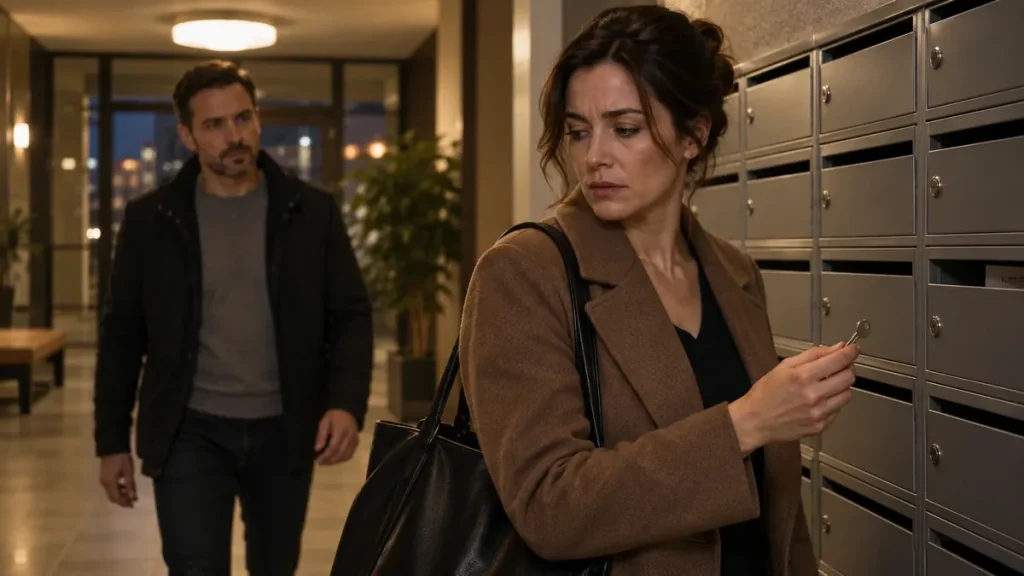
A Second Mailbox Key Wasn’t the Secret I Expected
The key appeared between my apartment fob and the small brass key to my mother’s house.
I noticed it because it was new enough to shine.
“What’s this?” I asked Marcus, holding up the ring.
He was standing at the stove, scraping onions into a pan. He looked at the key, then at me, and there was a pause so slight I might have missed it if we had not been married for eleven years.
“Mail key.”
“We already have a mail key.”
“For a PO box.”
He turned back to the stove.
There are moments in a marriage when the room changes before any facts do. The onions were still sizzling. The dishwasher still hummed. Nothing had happened except that my husband had just mentioned a private mailbox I did not know existed.
“Why do you have a PO box?”
“It’s nothing dramatic.”
Whenever someone says that, drama immediately becomes the leading theory.
“Then tell me the boring version.”
Marcus rubbed the back of his neck. “Can we eat first?”
We did not eat first.
I stood at the kitchen counter while my imagination took inventory. Secret correspondence. A business I did not know about. Something involving his estranged brother. For about thirty seconds, my mind even tried infidelity, though a rented mailbox seemed both too complicated and not complicated enough for that.
Marcus turned off the burner.
“I owe money,” he said.
The sentence was almost disappointing in its ordinariness.
“What do you mean, owe money?”
“Old debt. From before we got married.”
“How much?”
He named an amount: $18,700.
I sat down.
Eleven years earlier, Marcus had told me about a failed attempt to start a small catering company with a friend. I knew he had lost money. I knew he had spent several years cleaning up credit-card balances before we met.
What I did not know was that one account had never really gone away.
“I thought you paid all of that.”
“I thought I did too.”
The debt had been sold twice. For years, nobody contacted him. Then collection letters began arriving at our apartment the previous winter. Marcus panicked—not because we could not survive the debt, but because of a decision he had made without me.
He had answered the collector.
He had negotiated a payment plan.
He had started sending $420 a month from his personal checking account.
And after the first letter arrived while I was sorting mail, he rented a PO box.
“You moved financial mail out of our home so I wouldn’t see it.”
“Yes.”
“For eight months.”
“Yes.”
His willingness to admit each part made it harder to decide where to put my anger.
“Why?”
“Because I was ashamed.”
“That’s not an answer.”
“It is the answer.”
He sat across from me and folded his hands as if we were negotiating with strangers.
Marcus had grown up in a family where money failures were treated as character failures. His father recorded every household expense in a notebook and discussed missed payments with the seriousness of criminal confessions. Marcus’s older brother had filed for bankruptcy at twenty-nine, and their father referred to it for years as “what Stephen did to the family.”
I knew all of that. I had believed our marriage worked differently.
“You thought I would judge you?”
“No.”
“Then what?”
He looked at the key on the table.
“I thought you would help.”
“Of course I would help.”
“Exactly.”
I stared at him.

He tried again.
“You would have made a spreadsheet. You would have called somebody. You would have researched settlement options, checked our budget, moved money around. You would have fixed it with me.”
“That sounds terrible.”
“It sounds kind. It also means the stupidest thing I did in my twenties becomes something you have to carry in your forties.”
“We’re married. We carry things.”
“I know.”
“Clearly you don’t.”
That was the line that hurt him. I could see it, and at the time I was glad.
For two days, we discussed nothing else.
The facts were less catastrophic than the secrecy made them feel. The payments came from Marcus’s personal spending account, not our joint savings. He had not missed bills. The debt was not secured against our home. He had kept every letter and payment confirmation in a folder inside the PO box.
I reviewed the folder with him, partly because I needed to understand and partly because not reviewing it felt like pretending I was calm.
The more ordinary the paperwork looked, the stranger the deception felt.
“You weren’t protecting me from the debt,” I said. “You were protecting yourself from being seen with the debt.”
Marcus nodded.
That was the first moment I felt less angry and more sad.
Not forgiving. Not reassured. Just able to see the shape of what had happened.
A week later we met with a nonprofit credit counselor, not because the situation required rescue but because I wanted an outside person to confirm what we were dealing with. She reviewed the agreement and explained where Marcus should request written validation and how to document the remaining balance.
Then she asked us how we managed money as a couple.
We gave the answer we had always been proud of: joint household account, separate personal accounts, quarterly budget review, no need to justify small discretionary spending.
“And what counts as small?” she asked.
Neither of us answered immediately.
That was our problem.
We had rules about where money lived, but no rule about when private money became shared information.
Marcus believed that if he could pay the debt from his personal account without affecting our plans, it was his burden to manage. I believed that a recurring obligation large enough to last years belonged in the category of things spouses disclose, regardless of which account paid it.
Neither interpretation had ever been spoken aloud.
We created a new rule on the drive home.
Any debt, contract, recurring obligation, or financial risk above a set amount had to be disclosed. Disclosure did not mean the other person took control. It meant the information was shared.
“You don’t get to hide because you’re afraid I’ll help too much,” I said.
“And you don’t get to turn every disclosure into a project before asking what I want.”
“That sounds suspiciously like a boundary.”
“I’ve heard they’re fashionable.”
Trust did not snap back into place because we made a rule.
For months, I noticed mail differently. When Marcus mentioned an expense, part of me wondered what else sat outside the frame. Once, after he was unusually quiet about his phone, I asked a question so obviously suspicious that we both stopped mid-conversation.
“You’re doing it,” he said.
“I know.”
He handed me the phone. “It’s the dentist.”
I did not take it.
“Keep your dentist scandal.”
That small refusal mattered more than I expected.
Marcus kept the PO box until the payment plan ended. At first I wanted him to close it immediately, as if the box itself had committed the offense. He said he preferred having financial correspondence there until the account was resolved, and after some thought I agreed. The problem had never been the existence of a mailbox. It was the purpose of secrecy.
Every month, when he made the payment, he told me the new balance. I did not open the folder unless he asked.
Fourteen months later, the final confirmation arrived.
Marcus brought the envelope home unopened and set it on the kitchen table.
“You want to do the honors?” he asked.
“It’s your letter.”
He opened it himself.
We read the final balance together: zero.
Then he removed the bright PO-box key from his ring and placed it in my palm.
“I’m returning this tomorrow.”
I looked at it for a moment and handed it back.
“You can carry your own key.”
He smiled.
That was, in the end, what I wanted from our marriage too: not access to every locked thing, but confidence that neither of us was building a second life just to avoid being seen clearly in the first.