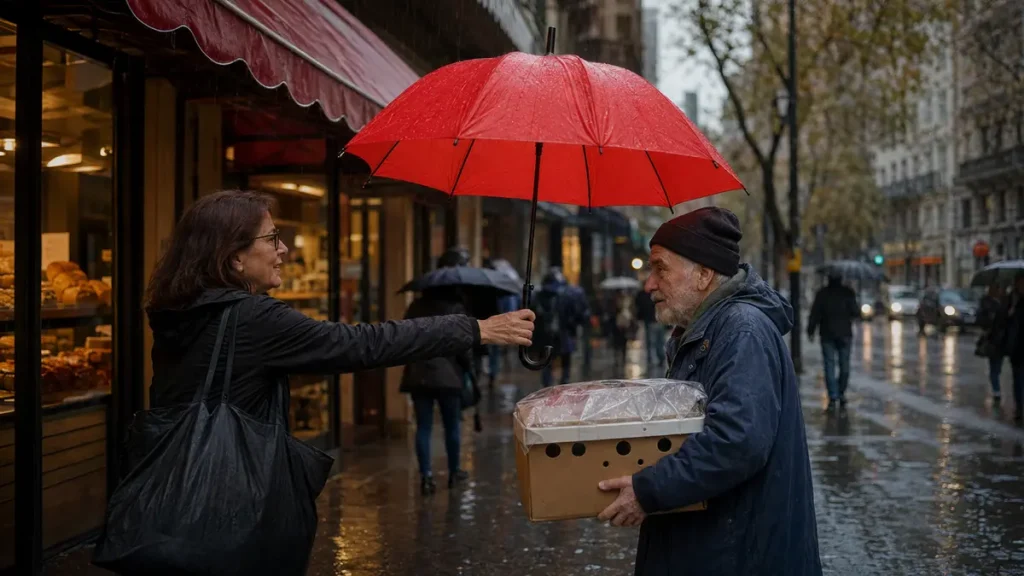
The Umbrella That Crossed the City
The umbrella crossed the city because Mara Voss took it without permission.
At 7:10 on a rain-heavy Tuesday, it stood in a brass holder outside Marlow’s Bakery on Fulton Street. Its red fabric had faded along the seams, and the curved wooden handle carried three small scratches. It did not look expensive. It looked used, familiar, and very much owned.
Mara noticed all of that before she took it.
She was forty minutes late for a job interview. Her own umbrella had snapped backward at the subway entrance, her résumé was damp at the corners, and one shoe made a soft squelching sound whenever she stepped.
She waited beneath the bakery awning, staring at the red umbrella while rain hammered the pavement.
“Borrowing,” she told herself.
Through the window, the baker was arguing with a flour supplier. Mara raised the umbrella toward him as if asking permission, but he never looked up.
She ran six blocks beneath it.
Inside the bakery, Julian Marlow ended his call and reached for the umbrella to move it away from the wind.
The brass holder was empty.
For several seconds, he simply stared.
His employee Tessa glanced over from the coffee machine. “Wasn’t there an umbrella?”
“Yes.”
“Maybe a customer took it by mistake.”
Julian went outside. The street was a blur of black coats, brake lights, and silver rain. The umbrella had vanished.
Tessa offered to check the security camera, but Julian shook his head too quickly.
“It’s only an umbrella.”
The sentence sounded false even to him.
Across town, Mara reached the glass office building with four minutes left before her interview. An elderly man stood beside the entrance, trying to cover a cardboard carrier with his jacket. A frightened terrier watched through a row of air holes.
“The clinic is across the avenue,” the man said when Mara stopped. “The bus driver wouldn’t let me board with him.”
The cardboard beneath his hands was already softening.
Mara looked through the revolving door. A receptionist was checking the clock.
“Is he yours?” Mara asked.
“Found him under the stairs in my building. He has a cut paw.”
Mara thought about the missing baker, the interview, and the word borrowing.
Then she held out the umbrella.
“Keep the carrier dry.”
The man blinked. “How do I return it?”
“You can’t return it to me.”
“Then whose is it?”
Mara’s face warmed. “Someone who deserves an apology.”
She entered the building without it.
The interview panel noticed her wet sleeve and asked whether she wanted time to compose herself. Mara said no. When they asked for an example of a difficult judgment call, she abandoned her rehearsed answer about quarterly reports.
She told them she had taken an umbrella, given it away, and was no longer sure whether the second act improved the first.
One interviewer laughed. Another did not.
“So what would you do differently?” the second woman asked.
“Ask before taking it,” Mara said. “And still help the dog.”
At the animal clinic, the elderly man introduced himself as Arthur Calder. The receptionist found no microchip in the terrier. A veterinary nurse cleaned the paw while Arthur filled out a form and quietly calculated what remained in his checking account.
A delivery rider rushed through the clinic door carrying a paper pharmacy bag beneath his jacket. His bicycle had a flat tire, and the bag was intended for a patient at St. Anne’s Hospital three blocks away.
Arthur looked at the umbrella leaning beside his chair.
“Medicine shouldn’t arrive as soup,” he said.
He gave it to the rider.
Back at Marlow’s Bakery, Tessa checked the camera anyway.
The recording showed Mara lifting the red umbrella, hesitating, and running away. Julian paused the image on her face.
“I can post this,” Tessa said. “Someone will recognize her.”
Julian almost agreed.
Then another camera angle showed the office entrance six blocks away. The neighboring building manager, responding to Tessa’s call, sent a short clip. In it, Mara handed the umbrella to Arthur and walked into her interview uncovered.
Julian watched the clip twice.
His late wife, Elise, had kept that umbrella beside the bakery door for twelve years. She lent it to customers during sudden storms and never wrote down their names. Julian had hated the habit because the umbrellas rarely returned.
After Elise died, the red one was the last that remained.
It had not been placed outside by accident. Julian had continued her ritual without admitting it—even to himself.
Now a stranger had followed the rule without knowing there was one.
“Don’t post her photograph,” Julian told Tessa.
“But she stole it.”
“She borrowed it badly.”
Tessa studied him. “That is not a legal category.”
“It should be.”
The delivery rider’s name was Sami Nassar. He walked his damaged bicycle to St. Anne’s and delivered the medicine dry. Outside the entrance, he found Claire Doyle fighting with a dead phone and an unmoving taxi line.
Claire had spent the night beside her brother after heart surgery. The operation had gone well, but relief had left her shaking harder than fear. She needed to reach her mother before the hospital did.
Sami let her use his phone. Then he offered the umbrella.
“I’m not going far,” he said.
His next delivery was two miles away.
Claire noticed the flat tire and understood the lie. She took the umbrella anyway, but first she removed a receipt from her bag and wrote: THANK YOU. I’LL MOVE IT FORWARD.
She folded the note around the umbrella strap.
Near the bus stop, Claire saw a boy in a green school sweater crouched beside a storm drain. A handmade wooden boat spun just beyond his reach.
“My mother made it,” he said. “She’ll think I didn’t care.”
Claire held the umbrella over him while he guided the boat back with a stick. When the bus arrived, she handed him the umbrella and repeated the only instruction Sami had given her.
“Pass it on.”
The boy, Theo, carried it to school. By lunchtime the storm had ended, and sunlight flashed on every wet window. He left the umbrella beside the playground fence during football practice.
At three o’clock, street violinist Lucía Reyes found it.
She had lost her usual market corner to a leaking awning and earned almost nothing all day. She opened the red umbrella upside down beside her violin case. Its bright fabric caught the attention of people hurrying past.
Children dropped coins into it. A fruit seller brought her tea. A tourist requested a song Lucía had not played since her conservatory audition.
When she packed at dusk, she found Claire’s note and small gold letters stamped on the strap: MARLOW’S—FULTON STREET.
Lucía carried the umbrella back to the bakery.
Julian was closing the shutters when he saw it in her hand.
He crossed the room so fast that Lucía stepped back.
“I didn’t steal it,” she said.
“Neither did the woman before you, apparently.”
He opened the umbrella indoors, something Elise had always scolded him for doing. Tucked inside were Claire’s note, a child’s damp bus ticket, and three coins Lucía had missed.
“Where has this been?” he asked.
Lucía told him what she knew, which was very little.
Julian ran his thumb over the scratched handle. For months, every object that had belonged to Elise had felt like evidence from a closed case. He had kept her favorite cup behind the register but never used it. Her apron still hung in the office. The umbrella had become another thing he protected from life.
Yet it had returned carrying proof that it had been useful.
The next morning, Julian placed it back in the brass holder with a handwritten card:
TAKE IT IF YOU NEED IT. RETURN IT IF YOU CAN. PASS IT ON IF YOU CANNOT.
Mara returned just after eight.
She had not slept well. She had searched the bakery’s name online after remembering the gold lettering on the strap, then spent the morning rehearsing an apology that sounded less selfish each time she revised it.
“I took your umbrella yesterday,” she told Julian.
“I know.”
Her eyes moved to the security camera. “I’m sorry.”
“Did you get the job?”
“I don’t know.”
Julian pointed to the card. “You could have asked.”
“Yes.”
“I might have said no.”
Mara accepted that without defending herself.
Julian poured two coffees. He told her about Elise, who believed a city became bearable only when people occasionally treated strangers as neighbors. He also admitted he had wanted to keep the umbrella untouched because it was easier than deciding what to do with his grief.
Mara reached for her wallet.
“I can replace it.”
“That would miss the point.”
Her phone rang before she could answer. The interviewer with the serious expression offered her the job. She said Mara’s story had been messy, but her answer about doing both necessary things—making amends and helping—had stayed with the panel.
Mara accepted. Then she used part of her first paycheck to buy six sturdy umbrellas for Julian’s brass holder.
Arthur later came to the bakery with the terrier, now named Patch, asleep inside his coat. Sami arrived during a delivery and recognized the red handle. Claire visited after her brother left the hospital. Theo brought a drawing of an umbrella covering a wooden boat. Lucía played outside the bakery on the first Saturday of every month.
They did not arrive together, and for a long time none of them understood how their days were connected.
The red umbrella kept leaving.
Once it returned with a repaired spoke. Another time it came back after three weeks with a grocery list in one pocket and a library card in the other. Some borrowers returned it quietly. Others passed it beyond Julian’s ability to trace.
He stopped trying.
On the anniversary of Elise’s death, rain began before dawn. Julian opened the bakery alone and found the brass holder empty except for a folded red note.
It read: SOMEONE NEEDED IT.
Julian placed the note beside Elise’s cup, filled the cup with coffee for the first time in a year, and unlocked the door.

Pingback: Restaurant Served Wrong Dinner—and Saved the Night